Need help?
Do you have a question about the Fender American Deluxe Precision and is the answer not in the manual?
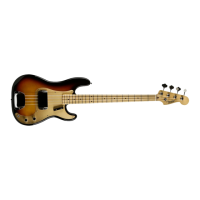
This document details the components and associated part numbers for an American Deluxe Precision Bass, providing a comprehensive guide for assembly, repair, and maintenance. The device is a high-quality electric bass guitar, designed for professional musicians and enthusiasts seeking a versatile and reliable instrument. Its construction emphasizes both playability and durability, incorporating features that enhance its sonic capabilities and user experience.
The American Deluxe Precision Bass serves as a musical instrument, specifically a bass guitar, designed to produce low-frequency sounds that form the rhythmic and harmonic foundation in various musical genres. Its primary function is to be played by a musician, typically by plucking or slapping its strings, to create bass lines that complement other instruments in an ensemble. The instrument's design integrates several key components that work in concert to achieve its sonic output and playability.
At its core, the instrument features a neck (Ref.# 1), available in Rosewood/Walnut (R/W) or Maple/Natural (M/N) finishes, which provides the fretboard for the musician to press down on strings, thereby altering their pitch. This neck is securely attached to the body (Ref.# 6), which is the main resonant chamber of the instrument. The body is offered in Alder Paint or Ash, contributing to the overall tonal characteristics. The connection between the neck and body is reinforced by a neck mounting plate (Ref.# 7) and associated mounting screws, ensuring stability and sustain.
The tuning keys (Ref.# 2), supplied as a set with bushings, are crucial for adjusting the tension of the strings, thus controlling their pitch and allowing the instrument to be tuned accurately. A bone nut (Ref.# 3) is positioned at the headstock end of the neck, providing a stable resting point for the strings and contributing to the instrument's sustain and tone. String retainers (Ref.# 4) with mounting screws help to maintain proper string angle and tension over the nut, further enhancing tuning stability.
The instrument's sound is captured by pickups (Ref.# 10, 11, 12). The American Deluxe Precision Bass features a neck pickup (Ref.# 10), a middle pickup (Ref.# 11), and a bridge humbucker dual Jazz Bass pickup (Ref.# 12). These pickups convert the vibrations of the strings into electrical signals. Each pickup is secured with mounting screws, and foam block weatherstrips (Ref.# 10, 11) are used to dampen unwanted vibrations and ensure a snug fit.
The electrical signals from the pickups are routed through a printed circuit board (Ref.# 13) and a series of controls (Ref.# 13, 14, 15, 16). These controls allow the musician to shape the instrument's tone and volume. Specifically, there's a 25K Audio control (Ref.# 13), a 250K Pan Alpha control (Ref.# 14), and 100KB Tocos (Ref.# 15) and 100KB CTS (Ref.# 16) controls. These controls are typically operated via knobs (Ref.# 17, 18, 19) that are knurled for easy grip and made of chrome for durability and aesthetic appeal. The knobs are secured with set screws. The output signal is then sent to an output jack (Ref.# 20), which connects the instrument to an amplifier or other audio equipment. The output jack assembly includes mounting hex nuts, lock washers, and flat washers for secure installation. A jack ferrule (Ref.# 21) provides a clean finish around the output jack.
The bridge assembly (Ref.# 23) is a critical component located at the opposite end of the strings from the nut. It anchors the strings to the body and allows for individual string height and intonation adjustments. The bridge assembly includes a bridge plate (Ref.# 24) and individual bridge sections (Ref.# 25) for each string. Intonation screws (Ref.# 26) with accompanying intonation springs allow for precise adjustment of each string's speaking length, ensuring accurate pitch across the fretboard. Height adjustment screws (Ref.# 27) enable the musician to set the action (string height) for optimal playability. An adjusting wrench (Ref.# 27) is provided for these adjustments. Ferrules (Ref.# 28) are used as string retainers at the bridge, providing a clean and secure string-through-body or top-load stringing option.
The instrument also incorporates active electronics, powered by a 9-volt battery (Ref.# 29). The battery is housed under a battery cover (Ref.# 29), which is secured with mounting screws. An insert (Ref.# 29) and foam block wearthestrip (Ref.# 29) are used to protect the battery and prevent rattling.
The American Deluxe Precision Bass is designed with several features that enhance its usability and performance for musicians.
The choice of neck finish (Rosewood/Walnut or Maple/Natural) (Ref.# 1) allows musicians to select a feel and aesthetic that suits their preference. Rosewood/Walnut typically offers a warmer tone and smoother feel, while Maple/Natural can provide a brighter tone and a snappier response.
The tuning keys (Ref.# 2) are designed for smooth and precise tuning, allowing for quick and accurate adjustments during practice or performance. The inclusion of a bone nut (Ref.# 3) is a premium feature, known for its ability to enhance sustain and provide a clear, resonant tone compared to synthetic materials.
The truss rod adjustment nut (Ref.# 5) and accompanying truss rod adjusting wrench (Ref.# 5) are essential for maintaining the proper relief of the neck. This allows musicians to fine-tune the neck's curvature to prevent fret buzz and ensure comfortable playability, adapting to changes in climate or string tension.
The variety of body finishes (Alder Paint or Ash) (Ref.# 6) not only offers aesthetic choices but also contributes to the instrument's tonal characteristics. Alder is often associated with a balanced tone, while Ash can provide a brighter, more articulate sound with good sustain. The specific body part numbers (e.g., 3 Color Sunburst, Black, Crimson Transparent, White Blonde, Natural, Teal Green Transparent, Purple Transparent) indicate a wide range of aesthetic options, allowing musicians to personalize their instrument's appearance.
The combination of neck, middle, and bridge pickups (Ref.# 10, 11, 12) provides a broad palette of tonal options. The humbucker bridge pickup, in particular, offers a fatter, hum-canceling tone, expanding the instrument's versatility beyond traditional Precision Bass sounds. The placement and type of pickups allow musicians to blend different tones to achieve their desired sound.
The comprehensive control layout (Ref.# 13, 14, 15, 16) with various potentiometers (25K Audio, 250K Pan Alpha, 100KB Tocos, 100KB CTS) gives the player extensive control over volume, tone, and pickup blending. This allows for on-the-fly sound sculpting to suit different musical contexts or personal preferences. The knurled chrome knobs (Ref.# 17, 18, 19) are designed for easy grip and smooth operation, even during energetic performances.
The bridge assembly (Ref.# 23) is highly adjustable, offering individual intonation screws (Ref.# 26) and height adjustment screws (Ref.# 27) for each string. This allows for meticulous setup, ensuring that the instrument plays in tune across the entire fretboard and that the string action is set to the player's exact preference, whether they prefer a low, fast action or a higher action for more dynamic playing. The included adjusting wrench (Ref.# 27) facilitates these precise adjustments.
The active electronics, powered by a 9-volt battery (Ref.# 29), provide a higher output signal and often a wider frequency response, offering more tonal flexibility and punch, especially when connected to an amplifier. The battery cover (Ref.# 29) is designed for easy access, allowing for quick battery changes when needed.
The design of the American Deluxe Precision Bass incorporates several features that simplify maintenance and ensure the longevity of the instrument.
The truss rod adjustment nut (Ref.# 5) and truss rod adjusting wrench (Ref.# 5) are key maintenance features. Regular adjustment of the truss rod is essential to counteract the tension of the strings and environmental changes (humidity, temperature) that can affect the neck's curvature. This allows for proper neck relief, preventing fret buzz and ensuring optimal playability over time.
The use of mounting screws throughout the instrument (e.g., for string retainers, neck mounting plate, pickups, battery cover) (Ref.# 4, 7, 10, 11, 29) facilitates easy disassembly and reassembly for repairs or component replacement. Standardized screw types simplify the process of finding replacements if needed.
The pickguard (Ref.# 9), available in Shell, Pearl, or Mint Green, is not only an aesthetic element but also serves to protect the body of the instrument from scratches and wear caused by playing. It is easily removable, allowing access to the electronics cavity for maintenance or modification.
The foam block weatherstrips (Ref.# 10, 11, 29) used with the pickups and battery are important for dampening vibrations and ensuring a secure fit. Over time, these can degrade, and their modular nature allows for easy replacement to maintain optimal performance and prevent rattling.
The printed circuit board (Ref.# 13) and individual controls (Ref.# 13, 14, 15, 16) are designed to be accessible for troubleshooting or replacement. The use of mounting hex nuts and lock washers (Ref.# 13, 14, 15, 16, 20) ensures that these components remain securely in place, even with frequent use.
The output jack (Ref.# 20) assembly, including mounting hex nuts, lock washers, and flat washers, is designed for durability. If the jack becomes loose or faulty due to repeated plugging and unplugging, these components allow for tightening or replacement. The solder lug (Ref.# 22) and mounting screw associated with it provide a secure electrical connection point for wiring, which is critical for signal integrity.
The highly adjustable bridge assembly (Ref.# 23) is a significant maintenance feature. The individual intonation screws (Ref.# 26) and height adjustment screws (Ref.# 27) allow for precise setup and re-setup of the instrument. This is crucial for maintaining proper intonation and action, especially after string changes or if the instrument experiences changes in climate. The availability of an adjusting wrench (Ref.# 27) ensures that these adjustments can be made easily by the user.
The battery cover (Ref.# 29) is designed for convenient access to the 9-volt battery, allowing for quick replacement when the active electronics' power runs low. This prevents interruptions during performance or practice. The mounting screws for the battery cover ensure it stays securely closed.
Overall, the American Deluxe Precision Bass is engineered with a modular approach to its components, making it relatively straightforward to perform routine maintenance, troubleshoot issues, and replace parts as needed, thereby extending the instrument's lifespan and ensuring consistent performance.
 General
| Neck Material | Maple |
|---|---|
| Fingerboard Material | Rosewood or Maple |
| Scale Length | 34" (864 mm) |
| Hardware | Chrome |
| Nut Width | 1.625" (41.3 mm) |
| Body Material | Alder |
| Bridge | High Mass Vintage |
| Tuners | Fender Lightweight Vintage Style |
| Controls | Master Volume, Pan Pot, 3-Band Active EQ with Treble, Mid and Bass |
| Weight | Approximately 9 pounds |