
 Need help?
Do you have a question about the New Holland Boomer 24 and is the answer not in the manual?
A structured schedule for maintenance tasks.
Daily or hourly maintenance checks and procedures.
Maintenance tasks to be performed every 50 hours.
Maintenance tasks to be performed every 100 hours.
Maintenance tasks to be performed every 300 hours.
Maintenance tasks to be performed every 600 hours.
Maintenance tasks to be performed every 1000 hours.
Identifies common symptoms for troubleshooting.
Troubleshooting guide for the hydraulic lift system.
Troubleshooting guide for the steering system.
Troubleshooting guide for the hydrostatic transmission.
A structured schedule for maintenance tasks.
Daily or hourly maintenance checks and procedures.
Maintenance tasks to be performed every 50 hours.
Maintenance tasks to be performed every 100 hours.
Maintenance tasks to be performed every 300 hours.
Maintenance tasks to be performed every 600 hours.
Maintenance tasks to be performed every 1000 hours.
Identifies common symptoms for troubleshooting.
Troubleshooting guide for the hydraulic lift system.
Troubleshooting guide for the steering system.
Troubleshooting guide for the hydrostatic transmission.
The provided document is an Operator's Manual for the New Holland Boomer™ 24 Compact Tractor. This manual serves as a comprehensive guide for owners and operators, detailing the proper adjustment, operation, and maintenance of the equipment to ensure optimal performance and longevity.
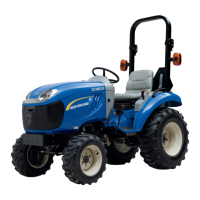
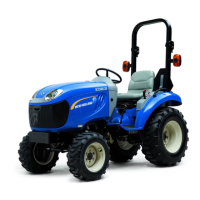
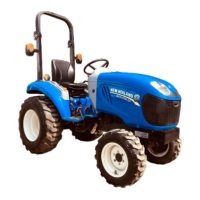
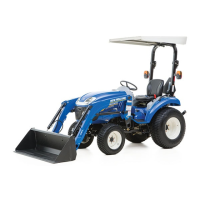
The New Holland Boomer™ 24 Compact Tractor is designed as a versatile agricultural machine capable of pulling, carrying, and powering a variety of mounted or towed equipment. Its primary function is to support various agricultural tasks, though its performance can be influenced by factors such as weather and terrain conditions. The tractor is equipped with a Power Take-Off (PTO) shaft, allowing it to drive compatible implements. It features a three-point linkage system for attaching equipment, as well as a drawbar hitch and hydraulic lift rocker for various operational needs. The hydrostatic transmission system facilitates smooth operation, and the machine includes controls for front-wheel drive, hydraulic power lift (HPL), and a drop rate control valve for precise implement management. Safety features, such as a seat belt and a Roll Over Protective Structure (ROPS), are integrated to protect the operator.
The manual emphasizes that the tractor should only be used for its intended purpose as outlined by the manufacturer. Operators must be familiar with the tractor and any mounted or towed equipment, adhering to all operational and safety practices. The manual covers various aspects of usage, including commissioning the unit, starting and stopping the engine, and moving the tractor.
Commissioning and Starting:
Moving and Parking:
Road Transport:
Working Operations:
Safety:
The manual provides a detailed maintenance schedule to ensure the tractor's reliability and extend its lifespan. It categorizes maintenance tasks by frequency: every 10 hours (daily), after the first 50 hours, every 50 hours, every 100 hours, every 300 hours, every 600 hours, and every 1000 hours, as well as general maintenance.
Daily (Every 10 hours):
After the first 50 hours:
Every 50 hours:
Every 100 hours:
Every 300 hours:
Every 600 hours:
Every 1000 hours:
General Maintenance:
Biodiesel Fuel Considerations: The manual provides specific guidelines for using Fatty Acid Methyl Ester Biodiesel (Biodiesel Fuel). It notes that Biodiesel Fuel blends must comply with EN14214 Specification Standards or ASTM D6751, and operators should consult their dealer to confirm approved blends. Using unapproved fuels can lead to severe engine and fuel system damage and may void the warranty. Biodiesel Fuel may require more frequent changes of engine oil, engine oil filter, and fuel filter elements. It can also attract moisture and remove rust/particles from fuel storage tanks, potentially shortening filter life. Long storage periods with Biodiesel Fuel in the system are not recommended, and the engine should run on Diesel Fuel for 20 hours to flush the system before storage. Spills must be cleaned immediately to prevent environmental damage and paint finish damage.
Storage:
Troubleshooting: The manual includes a troubleshooting section to address common issues related to the engine, hydraulic service brakes, hydraulic lift system, steering, hydrostatic transmission, and electrical system, providing guidance on identifying and resolving symptoms.
The overall scope of the manual covers normal operation and routine service, emphasizing that more complex periodical service, conversions, and repairs should be carried out by professional, trained personnel.
 General
| Engine Power | 24 hp |
|---|---|
| Transmission | Hydrostatic |
| Fuel Capacity | 6.6 gallons |
| 3-Point Hitch | Category 1 |
| Engine | 3-cylinder diesel |
| Drive | 4WD |
| PTO Speed | 540 RPM |


 To Next Page