
 Need help?
Do you have a question about the Toshiba GR-RT252WE-PMTH and is the answer not in the manual?
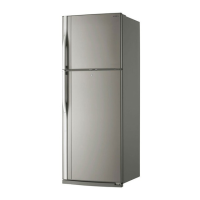
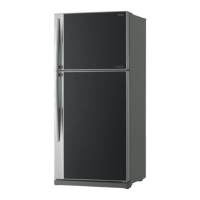
This document serves as the Owner's Manual for TOSHIBA Refrigerator Freezers, designed for home use. It provides comprehensive instructions and safety information for various models, including GR-RT252WE-PMTH, GR-RT303WE-PMTH, GR-RT329WE-PMTH, GR-RT234WE-DMTH, GR-RT252WE-DMTH, and GR-RT303WE-DMTH. The manual emphasizes safe and correct usage, maintenance, and troubleshooting to ensure the longevity and optimal performance of the appliance.
The TOSHIBA Refrigerator Freezer is designed to store food items at controlled temperatures, offering both refrigeration and freezing capabilities. It features separate compartments for fresh food and frozen items, each with independent temperature control. The refrigerator utilizes a compressor for cooling, which generates heat during normal operation, a characteristic noted as normal in the manual. The appliance is equipped with an automatic defrosting system, eliminating the need for manual defrosting and simplifying maintenance. An integrated deodorizer, built into the cold air passage, actively removes unpleasant odors from the compartments, ensuring a fresh environment for stored food.
Installation: The refrigerator should be installed on a strong and level floor. Adjustable legs allow for horizontal stabilization. Proper ventilation is crucial, requiring at least 30 cm (12 inches) of space at the top, 10 cm (4 inches) at the rear, and 5 cm (2 inches) on the left and right sides to ensure adequate air circulation. The appliance should be kept away from direct sunlight, gas ranges, or heaters to prevent reduced cooling efficiency and potential malfunction. It is also advised to avoid humid or wet locations to prevent corrosion or electrical leakage.
Temperature Control: Both the freezer and refrigerator compartments have independent temperature control switches. For normal operation, the temperature control switch should be set to the "Middle" position. If the refrigerator is not cold enough, the switch can be turned towards "MAX"; if it is too cold, it can be turned towards "MIN". The manual specifically warns that food in the refrigerator compartment may freeze if the ambient temperature is too low (e.g., during winter), in which case the control should be set to "MIN". High-moisture foods like tofu or vegetables are particularly susceptible to freezing if placed at the back of the compartment. For storing ice cream in the freezer, the temperature should be set between "Middle" and "MAX". Users are cautioned not to obstruct the cool air circulation outlets and inlets with food or containers, as this can lead to uneven cooling or freezing.
Ice Making: To make ice, users should fill the ice tray with water up to the indicated level. Overfilling can make it difficult to remove ice once frozen. To remove ice, the tray should be twisted as shown in the manual's figures.
Door Usage: Users are instructed to use the handle when closing the refrigerator door to prevent accidental finger injuries. It is important to ensure the door is closed properly, without any gaps between the frame and rubber packing, which could be caused by protruding containers. Leaving the door open for extended periods or frequently opening and closing it in short intervals is discouraged, as this allows warm air to enter, reducing cooling efficiency.
Food Storage: The manual advises against storing explosive substances such as aerosol cans with flammable propellants, ether, benzene, alcohol, thinner, adhesives, spray, LP gas, or other chemicals, as these can explode and cause accidents. Medicines, chemicals, or chemical reagents that are temperature-sensitive should not be stored in the refrigerator. Heavy objects or liquid containers should not be placed on top of the refrigerator, as spillage could affect electrical insulation or falling objects could cause injury. Users are also warned not to store bottles in the freezing unit, as they may break when their contents freeze.
Cleaning: Periodic cleaning of all parts is recommended to ensure the maximum life of the refrigerator. Before cleaning, the refrigerator's plug must be disconnected from the power socket. Users should be careful not to pull the cord or get it caught under the machine. Direct pouring of water onto the refrigerator is prohibited.
Accessory Removal for Cleaning: The manual provides instructions for easily removing accessory parts for cleaning. These include:
All parts should be replaced in reverse order of removal.
Troubleshooting: The manual includes a troubleshooting section for common issues:
Moving and Transporting: Before moving, all food should be removed. A large cloth should be placed under the refrigerator, and it should be leaned backward to drain water from the drain pan. When carrying, the refrigerator should be lifted from the bottom at designated positions, avoiding holding by the door or handle. During relocation, the refrigerator should not be laid on its side, as this can cause malfunction. After disconnecting the plug, wait at least 8 minutes before reconnecting to prevent compressor malfunction or rattling noises.
 General
| Brand | Toshiba |
|---|---|
| Model | GR-RT252WE-PMTH |
| Category | Refrigerator |
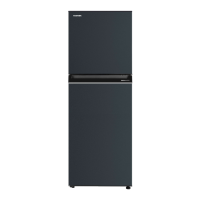
| Type | Top Freezer |
| Deodorizer | Yes |
| Voltage | 220-240V |
| Frequency | 50 Hz |
| Refrigerant | R600a |
| Shelves Material | Glass |
| Crisper | Yes |
| Ice Tray | Yes |
| Warranty | 1 Year |
| Origin | Thailand |
| Total Capacity | 252 L |
| Gross Total Capacity | 252 L |
| Refrigerator Capacity | 178 liters |
| Freezer Capacity | 74 liters |
| Cooling System | Fan Cooling |
| Weight (kg) | 50 |
| Dimensions (H x W x D) | 1520 x 550 x 600 mm |
| Dimensions (W x D x H) | 550 x 600 x 1520 mm |


 To Next Page