

 Need help?
Do you have a question about the Abbott i-STAT Alinity and is the answer not in the manual?
 General
| Sample Type | Whole blood, plasma, serum |
|---|---|
| Humidity | 10% to 90% non-condensing |
| Device Type | Point-of-care analyzer |
| Connectivity | Wi-Fi, Ethernet, USB |
| Power Source | Rechargeable lithium-ion battery, AC adapter |
| Operating Temperature | 15°C to 30°C |
| Display | Touchscreen LCD |
| Test Cartridges | Single-use cartridges |
| Sample Volume | 17-95 µL depending on test |
| Time to Results | 2 to 10 minutes |
| Regulatory Approvals | FDA, CE Mark |
| Battery Life | Approx. 8 hours |
Details safety regulations for electrical equipment and battery use across different regions.
Outlines electromagnetic compatibility regulations for the i-STAT Alinity system.
Lists country-specific radio and telecommunication regulations and type approvals.
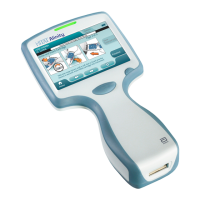
Describes the main components of the i-STAT Alinity system, including instrument, base station, and accessories.
Specifies the intended use of the i-STAT Alinity instrument for in vitro diagnostic testing.
Explains the operational principles of the i-STAT Alinity instrument's subsystems.
Details the selections and information available via the "More Options" button on the instrument.
Explains how to interpret various analyte results, including calculated and suppressed values.
Introduces the Lithium-Ion rechargeable battery as the instrument's power source.
Explains how the battery enables testing, recharges, and indicates battery level.
Describes the primary function of the Base Station for charging the battery.
Lists the functions of the Base Station, including charging, powering, and connectivity.
Describes the Electronic Simulator as a quality control device for instrument evaluation.
Explains how the Electronic Simulator verifies electronic and thermal functionality.
Introduces the portable printer for printing test results and quality control information.
Details the process for printing patient results wirelessly or via the Base Station.
Describes aqueous-based control solutions for verifying cartridge integrity.
Provides guidelines for storing control solutions refrigerated or at room temperature.
Explains the procedure for verifying instrument calibration stability and reagent lot impact.
Describes i-STAT cartridges containing test reagents for generating results.
Details shelf life, preparation, and storage requirements for i-STAT cartridges.
Provides a step-by-step guide for updating instrument software using a USB memory device.
Lists prerequisites and IT department involvement needed for network configuration.
Lists required equipment and software for network configuration.
Specifies how to name the network configuration file for instruments.
Defines the name of the wireless local area network (WLAN).
Controls WPA type, authentication method, and cipher types for wireless security.
Describes the three workspaces within CWi: Manage Profiles, Manage Users, Manage Organization.
Defines the Healthcare Organization identifier and the role of the Primary Manager.
Explains user roles and permissions within the CWi application.
Provides recommendations for defining users and managing HCO managers.
Guides the user through the process of creating a category for profile customization.
Lists required and optional categories used for building instrument profiles.
Configures settings for the Electronic Simulator testing schedule.
Sets up how the instrument responds to quality control testing results.
Configures settings for calibration verification test acceptability and results display.
Configures user-defined cartridge QC settings for compliance and lot number management.
Defines a liquid quality control testing schedule, including frequency and timing.
Controls access to training mode and workspace for creating training scenarios.
Allows creation of user-defined training scenarios for consistent operator learning.
Explains how to build STATNotes using items, sets, and predefined items.
Describes creating a Data Entry item to prompt for information via keypad or scanning.
Guides creating a list of items for operator selection.
Explains creating lists with text boxes for customized operator responses.
Prompts the operator to answer "Yes" or "No" if a repeat test is needed.
Prompts the operator to select a comment for patient results within the action range.
Applies a comment when QC Pass/Fail determination is set to Auto via eVAS.
Describes creating Result Notes sets from available Result Notes items.
Guides the creation of result notes sets for patient or control pathways.
Configures connections to remote systems for data transmission and reception.



 To Next Page
