Freeway Driving
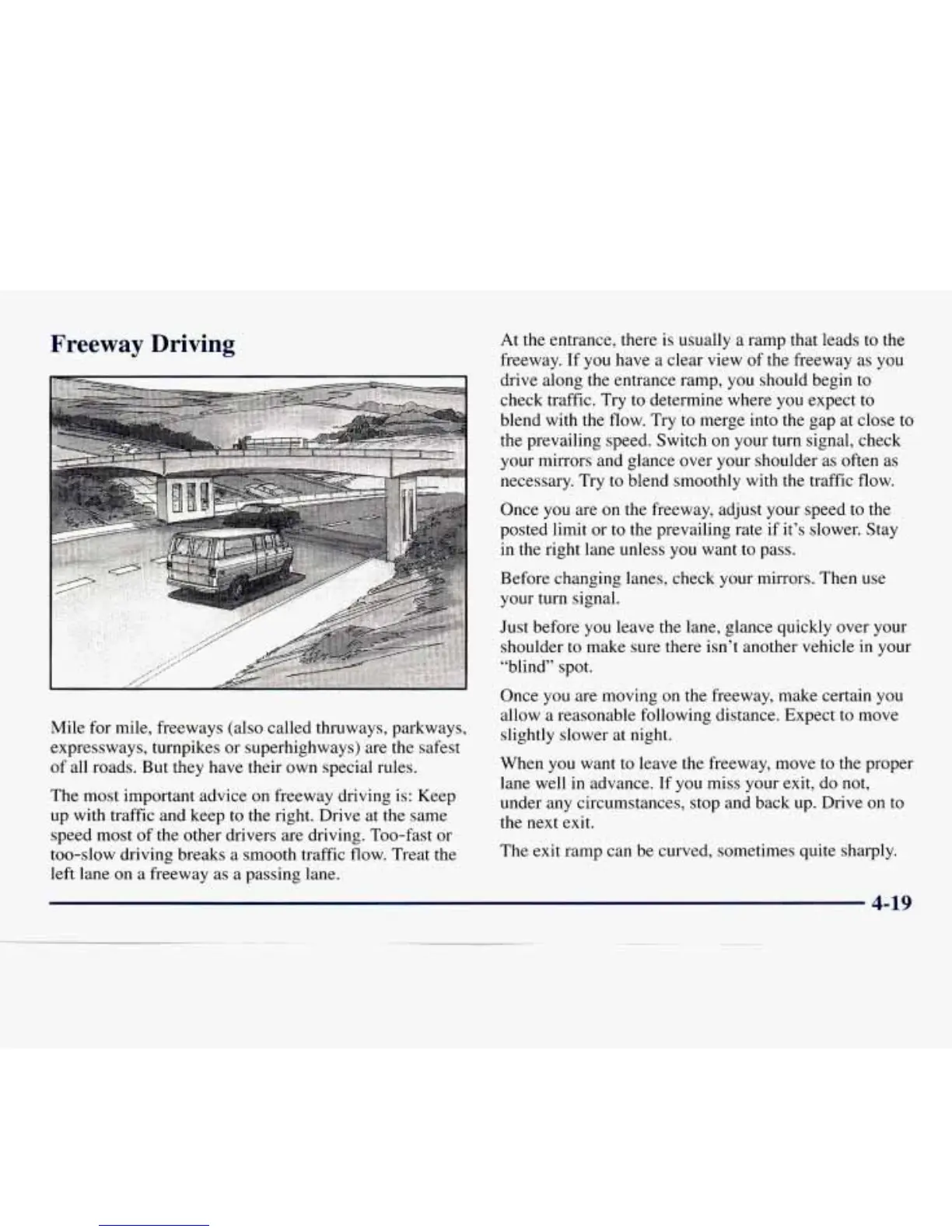
Mile for mile, freeways (also called thruways, parkways,
expressways, turnpikes or superhighways) are the safest
of
all roads. But they have their own special rules.
The
most important advice
on
freeway driving is: Keep
up with traffic and keep to
the
right. Drive
at
the same
speed most
of
the
other drivers are driving. Too-fast or
too-slow driving breaks
a
smooth traffic flow. Treat the
left
lane
on
a freeway as
a
passing lane.
At the entrance, there is usually a ramp that leads to the
freeway. If you have
a
clear view
of
the freeway
as
you
drive along the entrance ramp,
you
should begin
to
check traffic. Try to determine where you expect
to
blend with the
flow.
Try to merge into the gap at close
to
the prevailing speed. Switch
on
your turn signal, check
your mirrors and glance over your shoulder
as
often
as
necessary. Try to blend smoothly with
the
traffic flow.
Once
you
are on the freeway, adjust your speed to
the
posted limit or to the prevailing rate if
it’s
slower. Stay
in the right lane unless you want to
pass.
Before changing lanes, check your mirrors. Then use
your turn signal.
Just before you leave the lane, glance quickly over your
shoulder to make sure there isn’t another vehicle in your
“blind” spot.
Once you are moving
on
the freeway, make certain you
allow a reasonable following distance. Expect to move
slightly slower at night.
When you want
to
leave the freeway, move to the proper
lane well
in
advance. If
you
miss your exit, do
not,
under any circumstances, stop and back up. Drive
on
to
the next exit.
The exit ramp can
be
curved, sometimes quite sharply.
4-19


 To Next Page
 Loading...