
 Need help?
Do you have a question about the Durr Dental D-74321 and is the answer not in the manual?
Lists essential safety guidelines and operational rules.
Specifies personnel requirements and electric shock protection measures.
Illustrates installation in dry and wet suction systems.
Guides on preparing the valve and securing it during installation.
Instructions for connecting hoses and electrical wiring.
Provides the complete electrical circuit diagram.
Lists essential safety guidelines and operational rules.
Specifies personnel requirements and electric shock protection measures.
Illustrates installation in dry and wet suction systems.
Guides on preparing the valve and securing it during installation.
Instructions for connecting hoses and electrical wiring.
Provides the complete electrical circuit diagram.
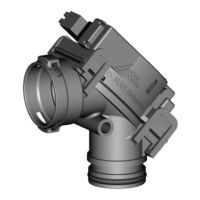
The Dürr Dental Station Selection Valve is a component designed to manage the volume flow between a dental suction unit and the hose manifold. This device is intended for installation within dental treatment units in dental surgeries or clinics, or in other areas of a dental suction unit for one treatment chair, such as for 12 o'clock suction. It is specifically designed to suction media associated with dental treatment, including water, saliva, dentine, and amalgam.
The station selection valve operates based on the state of a solenoid valve and a valve membrane.
Place Selection Valve Closed: In its normal state, the solenoid valve on the place selection valve is open. This allows atmospheric pressure to enter between the valve cap and the membrane through a small channel. As a result, the membrane rests on the valve body, effectively interrupting the suction power.
Place Selection Valve Open: When a suction hose is removed from the hose manifold, a voltage is applied to the solenoid valve on the place selection valve, actuating it. The vacuum from the suction unit then draws the air from the volume between the valve cap and the membrane until it is empty. This action causes the membrane to be raised, thereby releasing the suction power in the place selection valve.
Electrical Data:
General Data:
Ambient Conditions during Storage and Transport:
Ambient Conditions during Operation:
Classification:
Electromagnetic Compatibility (EMC):
Intended Purpose and Use: The valve's primary purpose is to open the volume flow between the suction unit and the hose manifold. It is intended for use as a suction valve in dental treatment units, handling typical dental media. Any usage outside this scope is considered improper.
Hose Materials: For waste connections and suction lines, only flexible spiral hoses made of PVC with integrated spirals or equivalent hoses that are resistant to dental disinfectants and chemicals should be used. Rubber hoses, completely PVC hoses, or hoses that are not sufficiently flexible are explicitly prohibited. Plastic hoses require regular inspection and replacement due to aging.
Electrical Connections: The supply voltage must meet the requirements for two means of patient protection (MOPP) as per IEC 60601-1, specifically 24 V AC/DC, 50–60 Hz, at least 3 VA.
Installation: The valve can be installed in both dry and wet suction systems. Proper installation involves pushing hose adapters and hose connector sockets onto the valve, inserting securing rings, connecting hoses to sleeves, and securing them with hose clamps. The control line must be connected according to the provided circuit diagram.
Commissioning: Before commissioning, an electrical safety check must be performed in accordance with local regulations. The aspiration function, connections, hoses, and device must be checked for leaks.
General Safety Notes:
Specialist Personnel: Installation, readjustments, alterations, upgrades, and repairs must be carried out by Dürr Dental or specifically approved and authorized qualified personnel.
Protection from Electric Shock:
EMC Rules:
Original Parts: Only Dürr Dental parts, accessories, and wear parts specifically approved by Dürr Dental should be used. Non-authorized accessories can negatively affect EMC and unit function.
Transport: The unit should only be transported in its original packaging. Dürr Dental is not responsible for damage during transport due to incorrect packaging. Packing materials should be kept out of reach of children.
Disposal: Potentially contaminated parts must be decontaminated before disposal. Uncontaminated parts should be disposed of according to local waste disposal regulations. Consult the dental trade supplier for questions about correct disposal.
Troubleshooting (Tips for Service Technicians): Any repairs beyond routine maintenance must be performed by suitably qualified personnel or Dürr Dental service technicians.
 General
| Brand | Durr Dental |
|---|---|
| Model | D-74321 |
| Category | Dental equipment |
| Language | English |



 To Next Page