Need help?
Do you have a question about the Hach TU5300 sc and is the answer not in the manual?
Details the nephelometry method using scattered light at 90 degrees.
Covers operating and storage temperatures, humidity, and altitude limits.
Includes detection limit, accuracy, repeatability, and resolution.
Explains DANGER, WARNING, CAUTION, and NOTICE symbols and their meanings.
Details instrument labels, including Class 1 laser warnings and handling.
Advises on avoiding interference and FCC/IC compliance for RFID.
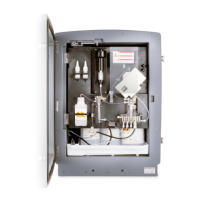
Lists and identifies the physical parts of the turbidimeter.
Provides initial setup advice, altitude limits, and installation overview.
Details procedures for mounting the instrument on a wall using a bracket.
Describes how to mount the instrument directly to a wall without a bracket.
Guides on checking and installing the desiccant cartridge.
Covers connecting to SC controller and installing optional modules.
Covers sample line connections, flow regulators, and shutoff valves.
Details how to adjust the flow regulator for optimal performance.
Outlines procedures for calibrating and verifying the instrument's accuracy.
Recommends tasks and intervals for instrument upkeep.
Describes methods for cleaning the instrument, vial, and compartment.
Guides on replacing the vial, desiccant cartridge, and tubing.
Directs users to resources for resolving instrument operational problems.
Details the nephelometry method using scattered light at 90 degrees.
Covers operating and storage temperatures, humidity, and altitude limits.
Includes detection limit, accuracy, repeatability, and resolution.
Explains DANGER, WARNING, CAUTION, and NOTICE symbols and their meanings.
Details instrument labels, including Class 1 laser warnings and handling.
Advises on avoiding interference and FCC/IC compliance for RFID.
Lists and identifies the physical parts of the turbidimeter.
Provides initial setup advice, altitude limits, and installation overview.
Details procedures for mounting the instrument on a wall using a bracket.
Describes how to mount the instrument directly to a wall without a bracket.
Guides on checking and installing the desiccant cartridge.
Covers connecting to SC controller and installing optional modules.
Covers sample line connections, flow regulators, and shutoff valves.
Details how to adjust the flow regulator for optimal performance.
Outlines procedures for calibrating and verifying the instrument's accuracy.
Recommends tasks and intervals for instrument upkeep.
Describes methods for cleaning the instrument, vial, and compartment.
Guides on replacing the vial, desiccant cartridge, and tubing.
Directs users to resources for resolving instrument operational problems.
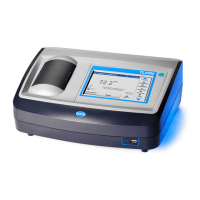
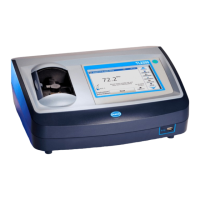
The Hach TU5300 sc and TU5400 sc turbidimeters are designed for measuring low-range turbidity, primarily in finished drinking water applications. These instruments operate by measuring scattered light at a 90-degree angle, encompassing a 360-degree radius around the incident light beam axis. They are intended for use with an SC controller, which displays the turbidity values.
The turbidimeters utilize nephelometry, a method that measures the intensity of light scattered by particles suspended in a liquid. The scattered light is collected at a 90-degree angle to the incident light and from all 360 degrees around the sample vial, providing a comprehensive measurement. The primary compliance method for these instruments is DIN EN ISO 7027.
An optional RFID module is available, which allows for easy comparison between process and laboratory turbidity measurements. This module receives and transmits information and data at a frequency of 13.56 MHz. The use of instruments with the optional RFID module is permitted in various regions, including EU, EFTA, Turkey, Serbia, Macedonia, Australia, Canada, US, Chile, Ecuador, Venezuela, Mexico, Brazil, South Africa, India, Singapore, Argentina, Columbia, Peru, and Panama. Users should contact the manufacturer if they intend to use the RFID module outside these specified regions to ensure compliance with national laws.
The instruments also feature PROGNOSYS predictive diagnostic software when connected to an SC controller equipped with PROGNOSYS. This software provides advanced diagnostic capabilities to help predict and prevent potential issues.
The turbidimeters are designed for indoor wall mounting in a vertical and level position. Installation can be done either with a wall mount bracket or directly onto a wall. The mounting hardware for the wall mount bracket is supplied by the user, while for direct wall installation, the user also supplies the mounting hardware. The instrument is rated for an altitude of up to 3100 m (10,710 ft) maximum.
The instrument includes a programmable button and a status indicator light, which provides information about the instrument's operational status. The process head can be opened and closed, and there are cleaning lid screws and a cleaning lid for access to the sample vial. Sample inlet and outlet connections are provided for 1¼-in. OD tubing. An extension connector for accessories and a sensor cable are also part of the setup.
The turbidimeters require a desiccant cartridge to be installed to prevent damage to the instrument. The desiccant cartridge has an indicator that changes color from blue (not expired) to pink (expired), indicating when replacement is necessary.
An optional flow sensor can be installed to monitor the sample flow. This sensor identifies if the flow is within specifications and triggers warnings on the controller display and status indicator light for no flow, low flow, or high flow conditions.
An optional automatic cleaning module is available, which cleans the inside of the process vial at selected time intervals.
Connecting the instrument to an SC controller is straightforward. Users should install the latest software version on the SC controller before connecting the turbidimeter. Once connected and powered, the SC controller will detect the instrument and display the measured turbidity value.
Plumbing the instrument involves connecting the sample inlet and outlet tubing, along with a flow shutoff valve and a flow regulator (supplied by the user). It is crucial to ensure the drain tube is free of obstructions to prevent pressure buildup. The flow rate can be adjusted using the flow regulator to optimize performance and minimize bubble formation in the vial.
Regular maintenance is essential for the optimal performance of the turbidimeters. A recommended maintenance schedule includes tasks such as cleaning the vial, cleaning the vial compartment, replacing the vial, replacing the desiccant cartridge, and replacing the tubing. The frequency of these tasks may vary depending on water quality, ambient humidity, temperature, and sample temperature.
Before performing maintenance, the sample flow to the instrument should be stopped, and the instrument allowed to cool. The output behavior during maintenance can be set via the SC controller's menu.
Cleaning the vial is necessary when contamination is observed or when "VIAL CLARITY" appears on the controller display. This can be done using an optional vial wiper or by following illustrated steps involving a syringe and a dilute hydrochloric acid solution. Care must be taken to avoid spilling water into the vial compartment.
The vial compartment should be cleaned only when contaminated, using a soft tool that will not damage the instrument. Options for cleaning include a vial compartment wiper, micro fiber cloth, or lint-free cloth for dust, and cloth, water, and cleaning agent for liquid or oil.
Vial replacement is guided by the controller display. A vial replacement tool is recommended to protect the new vial from contamination during installation. When replacing the vial, it is important to ensure no particles fall into the vial compartment and that the vial nut is tight. If an automatic cleaning module is installed, it should be held vertically during vial replacement to prevent breakage.
The desiccant cartridge needs to be replaced when indicated by the controller display or when the indicator turns pink.
Tubing replacement is required if the tubing becomes blocked or damaged. This involves stopping the flow to the instrument and re-plumbing the system.
Safety precautions are emphasized throughout the manual, including warnings about chemical exposure, burn hazards from hot liquids, personal injury from laser exposure (never remove covers), and cuts from glass components. Users are advised not to disassemble the instrument for maintenance and to contact the manufacturer if internal components need cleaning or repair.
 General
| Resolution | 0.0001 NTU |
|---|---|
| Sample Temperature | 0 to 50 °C (32 to 122 °F) |
| Sample Flow Rate | 200 to 750 mL/min |
| Power Supply | 100 to 240 VAC, 50/60 Hz |
| Storage Temperature | -20 to 60 °C (-4 to 140 °F) |
| Enclosure Rating | IP66 |
| Detector | Silicon Photodiode |
| Measurement Range | 0 to 1000 NTU |
| Light Source | LED |
| Operating Temperature | 0 to 50 °C |
| Outputs | 4-20 mA, Ethernet |


 To Next Page