
 Need help?
Do you have a question about the KTM 350 EXC-F 2016 and is the answer not in the manual?
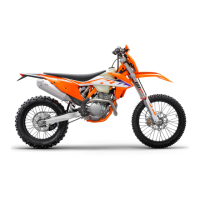
This document provides setup instructions for the 2016 KTM 350 EXC-F and 350 XCF-W models, ensuring the vehicle is properly prepared before delivery to the customer. It outlines a series of tasks, from unpacking and initial assembly to final checks and adjustments, all designed to be performed by a fully trained mechanic. The instructions are structured to guide the user through each step, emphasizing safety and proper technique.
The setup process begins with unpacking the motorcycle from its transport packaging. This involves removing the box and plastic packaging, followed by unpacking any separate enclosures and verifying the completeness of the supply based on the packing list. A lift stand is required to safely handle the motorcycle during this stage. The tension belt securing the footrest mount is carefully loosened and removed, and with the help of an assistant, the vehicle is taken off the palette and positioned on the lift stand. A crucial step at this point is to check the vehicle for any transport damage. For models in Package 2, the headlight mask with the headlight is removed early in the process. For Package 12 models, the shock absorber is installed after the initial unpacking.
A significant part of the setup involves positioning the fork legs and tightening the triple clamp screws. Specific torque values are provided for the top and bottom triple clamp screws, varying slightly between different regional models (EXC-F BR, XCF-W, 350 EXC-F US versus EXC-F EU/AU, All Six Days models). The instructions highlight the importance of aligning the milled grooves on the fork legs with the top edge of the upper triple clamp and positioning the bleeder screws toward the front. For models with adjustable damping, the location of the rebound (red) and compression (white) adjusting screws is noted.
Handlebar installation is another detailed step. This involves removing existing screws and handlebar clamps, positioning the handlebar supports correctly, and then mounting and tightening the screws with a specified torque and Loctite® 243TM. The instructions emphasize even positioning of the handlebar supports and ensuring cables and wiring are correctly routed. The handlebar clamps are then positioned, and their screws are tightened evenly, with a note to align the handlebar markings with the center of the clamps and maintain equal gap widths.
Electrical connections and component positioning are also covered. For All EXC-F models, the indicator lamp with black and violet cables is inserted into its socket. For All XCF-W models, the pull switch is connected to yellow and white cables, and the speedometer and connector board are positioned and tightened. The routing of cables for controls on both the right and left halves of the handlebar is illustrated, with specific attention to the clutch line and wiring harness. For All EXC-F models, the fuel tank is temporarily removed to position and secure the turn signal wiring harness against the main wiring harness using cable ties, followed by connecting the turn signal wiring harness and reinstalling the fuel tank.
Further assembly steps include mounting the turn signals, connecting their plug-in connections (black/brown for right, violet/brown for left), and installing the front fender and front wheel for specific regional models (EXC-F EU/AU/BR, EXC-F Six Days). The headlight mask with the headlight is refitted, and the fuel tank breather is mounted correctly. The handlebar cushion is secured with cable ties. Footrests are mounted with springs and pins, secured by washers and cotter pins, with a special tool recommended for the footrest spring. For specific regional models, the license plate holder, lamp, turn signals, and reflector are mounted, and their electrical components are connected, with color-coded instructions for left (red) and right (green) turn signal connectors.
Battery handling is a critical safety aspect. Warnings about the risk of injury from battery acid and gases are prominently displayed, advising the use of protective clothing and goggles, avoiding contact with acid and gases, keeping sparks and flames away, and ensuring good ventilation during charging. First aid measures for skin and eye contact are also provided. Environmental warnings highlight the proper disposal of batteries and hazardous substances like oil, grease, and fuel. The battery is filled, charged, and installed according to instructions, including specific torque values for battery terminals and the use of contact disks. Notes on battery maintenance, such as regular charging and avoiding deep discharge, are included to prolong battery life.
The manual also details the process of checking and adjusting the headlight setting. This involves positioning the vehicle in front of a light wall, marking the low beam height, and then a second mark 5 cm (2 in) below it. The vehicle is then positioned 5 m (16 ft) away, and with the rider seated, the low beam is switched on to check if the light-dark boundary aligns with the lower mark. If not, the headlight range is adjusted by loosening a screw and pivoting the headlight, then retightening the screw.
Installing the shock absorber involves pushing aside a splash protector, positioning the shock absorber, and then mounting and tightening the top and bottom screws with specific torque values and Loctite® 2701M. A special note warns against greasing the Teflon-coated heim joint to prevent damage.
Front wheel installation includes checking wheel bearings, cleaning and greasing shaft seal rings and bearing surfaces, inserting spacers, positioning the front wheel, and inserting the wheel spindle. For All Six Days models, the brake disc guard alignment is specified. The front wheel spindle screw is tightened, and the hand brake lever is activated multiple times to engage the brake linings. After removing the motorcycle from the lift stand, the front wheel brake is pulled, and the fork is pushed down hard several times to align the fork legs before fully tightening the fork stub screw.
The front fender is positioned and mounted with screws tightened to a specified torque.
Seat removal and mounting are straightforward, involving a single screw.
Fuel tank removal and installation are detailed, with strong warnings about fire hazard and poisoning due to fuel. Safety precautions include switching off the engine, avoiding open flames, and handling fuel carefully to prevent spills. The process involves detaching fuel pump connectors, removing tubes, and thoroughly cleaning plug-in connections with compressed air to prevent dirt from entering the fuel line. Wash cap sets are used to protect connections. Horn connectors and screws with collar bushings are removed for specific models. The fuel tank is then lifted off, often requiring the removal of spoilers from the radiator bracket. Installation reverses these steps, ensuring no cables are trapped and all connections are secure.
Throttle cable routing is checked to ensure both cables are routed side by side behind the handlebars and above the fuel tank bearing. If incorrect, the routing must be corrected.
Air filter box cover installation involves inserting the cover into the rear area and clipping it into the front area.
The manual also covers opening and closing the filler cap, with instructions to press a release button and turn the cap. It emphasizes running the fuel tank breather hose without kinks.
Refueling instructions reiterate safety warnings about fire and poisoning and advise using clean fuel that meets specified standards to prevent premature clogging of the fuel filter.
Finally, the document provides instructions for setting kilometers or miles and speedometer functions. This involves navigating a setup menu on the display using buttons to select and activate desired units or functions. The process includes pressing buttons for specific durations and waiting for settings to be stored, with notes on automatic saving if no input is detected for a certain period. Setting the clock follows a similar procedure, allowing adjustment of hours and minutes.
 General
| Engine Type | Single cylinder, 4-stroke |
|---|---|
| Displacement | 349.7 cc |
| Bore x Stroke | 88 mm x 57.5 mm |
| Compression Ratio | 12.3:1 |
| Cooling System | Liquid cooled |
| Transmission | 6-speed |
| Starter | Electric starter |
| Fuel System | Keihin EFI, throttle body 42 mm |
| Ignition | Keihin EMS |
| Front Tire | 90/90-21 |
| Rear Tire | 140/80-18 |
| Front Wheel Travel | 300 mm |
| Ground Clearance | 370 mm |
| Seat Height | 970 mm |
| Dry Weight | 107.5 kg |
| Clutch | Wet multi-disc clutch |
| Frame | Central double-cradle type 25CrMo4 steel |
| Front Suspension | WP USD Ø 48 mm |
| Rear Suspension | WP Suspension PDS shock absorber |
| Front Brake | Disc brake, 260 mm |
| Rear Brake | Disc brake 220 mm |
| Wheelbase | 1, 482 ± 10 mm |



 To Next Page