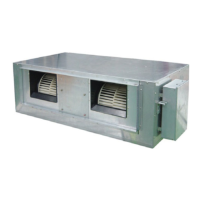
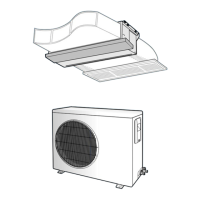
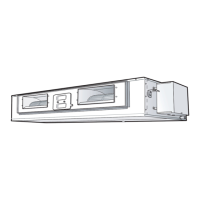
This document serves as a user's manual for Samsung System Air Conditioners, covering various indoor and outdoor unit models.
Function Description
The Samsung System Air Conditioner is designed to provide heating and cooling functionalities for indoor environments. It operates by absorbing heat from outside air and transferring it indoors for heating, and vice versa for cooling. The system can be controlled through various interfaces, including a wireless remote controller, a wired remote controller, a receiver & display unit, a centralized controller, and a function controller.
The air conditioner units are available in different configurations:
- Indoor Units: EH052EAMC, EH070EAM(1)C, DH094EAMC, DH105EAMC, DH140EAMC.
- Outdoor Units: UH052EAMC, UH070EAM(1)C, UH094EAM1C, UH105EAMC, UH105GAMC, UH140GAMC.
The system includes a compressor (COMP) for compressing gases, a blower and fan for creating air currents, and heat exchangers (ASSY EVAP / ASSY COND) for transferring heat between fluids. An ASSY CONTROL BOX manages air conditioning, measurement, and limits, while a motor drives the mechanical components.
Important Technical Specifications
The manual provides detailed technical specifications for various models:
Capacity (W):
- Cooling: Ranges from 5500W (EH052EAMC/UH052EAMC) to 14700W (DH140EAMC/UH140GAMC).
- Heating: Ranges from 6300W (EH052EAMC/UH052EAMC) to 16000W (DH140EAMC/UH140GAMC).
Power Supply:
- 1Ø, 220-240V~, 50Hz for models like EH052EAMC/UH052EAMC, DH094EAMC/UH094EAM1C.
- 3Ø, 380-415V~, 50Hz for models like DH105EAMC/UH105GAMC, DH140EAMC/UH140GAMC.
Power Input (W):
- Cooling: Ranges from 1950W to 5500W.
- Heating: Ranges from 2000W to 5700W.
Running Current (A):
- Cooling: Ranges from 6.4A to 17.5A.
- Heating: Ranges from 6.5A to 17.5A.
Max Input Power (W): Ranges from 2400W to 6500W.
Max Input Current (A): Ranges from 8.1A to 23.2A.
Refrigerant (g, R410A): Ranges from 1500g to 3300g.
Max Pressure (Mpa): Ranges from 3.0 Mpa to 3.2 Mpa.
Fuses:
- Outdoor PBA Fuse: 250V, 5A, TIME-LAG, GLASS, 5x20mm.
- CCH Fuse: 250V, 2A, Time-Lag.
- Indoor Power PBA Fuse: 250V, 3.5A, TIME-LAG, GLASS, 5.2x20mm or 250V, 5A, TIME-LAG, GLASS, 5.2x20mm.
Temperature and Humidity Ranges for Operation:
- Heating: Outdoor Temperature -5°C to 24°C approx., Indoor Temperature 15°C to 27°C approx.
- Cooling: Outdoor Temperature -5°C to 43°C approx., Indoor Temperature 21°C to 32°C approx., Indoor Humidity 80% or less.
- Drying: Outdoor Temperature -5°C to 43°C approx., Indoor Temperature 21°C to 32°C approx.
- The standardized temperature for heating is 7°C. Heating capacity may reduce below 0°C outdoor temperature. Cooling at over 32°C indoor temperature may not reach full capacity.
Usage Features
Control Interfaces:
- Wireless Remote Controller: An optional accessory with buttons for mode selection, temperature adjustment, fan speed, filter reset, on/off timer, and on/off. It also displays operating mode, set temperature, fan speed, air flow direction, on/off timer settings, and battery discharge.
- Receiver & Display Unit: An optional wall-mounted accessory for concealed and standard type units. It includes indicators for filter sign, fan, timer, remote control sensor, and on/off (with frost removal indication for heat pump models).
- Wired Remote Controller: Provides comprehensive control with displays for operating mode, removing frost, communication error, centralized controller indicator, on/off timer settings, test indicator, temperature adjustment, fan speed, air flow direction, filter sign, on/off, and mode selection.
- Centralized Controller: An optional wall-mounted accessory for managing multiple units. It features an operating lamp, "All On" and "All Off" buttons, on/off indicators, on/off buttons, and an index. An operating mode switch allows selection between Cool/Auto/Heat modes.
- Function Controller: An additional optional wall-mounted controller used with the centralized controller. It offers similar controls and displays as the wired remote controller, including room number display and indoor unit selection.
Operating Recommendations:
- Heating Performance: Heating performance decreases as outside air temperature drops. Additional heating appliances are recommended if the room is not warm enough.
- Frost Formation: Frost may form on the outdoor unit in HEAT mode when outside temperature is low and humidity is high. The system will automatically trigger defrost mode (3-14 minutes), during which heating stops. Normal operation resumes after defrosting.
- High Indoor/Outdoor Temperatures (HEAT mode): The outdoor unit's fan and compressor may stop intermittently. This is normal, and the unit will restart automatically.
- Power Failure: The unit switches off during a power failure and restarts automatically when power returns.
- Temperature and Humidity Ranges: Operating outside recommended ranges can trigger automatic protection, cause water leakage due to freezing heat exchangers, or lead to condensation on the indoor unit.
Maintenance Features
Cleaning Your Air Conditioner:
- Air Filter Cleaning: The air filter should be cleaned every 2 weeks to remove accumulated dust.
- Procedure:
- Switch off the electric circuit breaker before cleaning.
- Pull the air filter to the right or left.
- Pull out the air filter.
- Remove dust from the air filter using a vacuum cleaner or brush. For heavy dust, wash the filter in warm detergent water and shake it vertically.
- Dry the air filter.
- Insert the filter back into the unit.
- After cleaning, press the "Filter Reset" button on the remote controller.
- Important Note: Do not operate the air conditioner without the filter.
- Outdoor Unit Heat Exchanger: If the outdoor unit's heat exchanger gets dusty, cooling efficiency may decrease. Clean it with water, being careful as the surface can be sharp.
Troubleshooting (Solving Common Problems):
- Unit Not Operating: Check if the circuit breaker is switched on.
- Remote Controller Issues:
- Wired Remote: If "TEST" is displayed, turn off the unit and contact the dealer. If turning on/off is delayed, it's normal for group-controlled units (up to 32 seconds).
- Wireless Remote: Ensure no obstacles between the remote and the sensor, check/replace batteries, and stay within 7 meters of the unit. Point the remote at the indoor unit's sensor. Strong ambient light (e.g., three-wavelength light, neon sign) can interfere; use the remote closer to the sensor.
- Insufficient Cooling/Heating:
- Verify the correct operating mode is selected.
- Check if room temperature is too low or too high for the selected mode.
- Clean the air filter if it's blocked by dust.
- Ensure no obstacles are in front of the outdoor unit.
- For heating, confirm the required temperature is set correctly and increase fan speed if needed.
Disposal:
- Batteries: Remove battery cells before disposing of the device and recycle them safely.
- Unit Disposal: Consult your dealer for proper disposal. Incorrect removal of pipes can release refrigerant, causing injury and environmental damage.
- Packaging Material: Recycle or dispose of packaging materials responsibly.
- Storage/Shipping: Never store or ship the air conditioner upside down or sideways to prevent compressor damage.
- Child Safety: The appliance is not intended for use by young children or infirm persons without supervision. Children should be supervised to ensure they do not play with the appliance.
- Refrigerant R410a: "Do not vent R410a into atmosphere: R410a is a fluorinated greenhouse gas, covered by Kyoto Protocol, with a Global Warming Potential (GWP)=1975."
- WEEE Directive: The product should not be disposed of with household waste at the end of its life. Separate collection and responsible recycling are required in the European Union and other countries with separate collection systems. Contact retailers or local government offices for safe recycling information. Business users should consult their supplier.


 To Next Page
 Need help?
 General