Need help?
Do you have a question about the Zanussi ZFG06400WA and is the answer not in the manual?
Guidance on how to freeze fresh food quickly and effectively.
Information on storing commercially frozen food and capacity.
Instructions on how to handle frozen food during a power outage.
Essential conditions and locations for correct appliance installation.
Specific guidelines for air circulation and placement around the appliance.
Explains the color coding of the mains lead wires and terminal connections.
Guidance on how to freeze fresh food quickly and effectively.
Information on storing commercially frozen food and capacity.
Instructions on how to handle frozen food during a power outage.
Essential conditions and locations for correct appliance installation.
Specific guidelines for air circulation and placement around the appliance.
Explains the color coding of the mains lead wires and terminal connections.
This document is a user manual for a Zanussi freezer, model ZFG06400WA, providing essential information for its installation, operation, and maintenance.
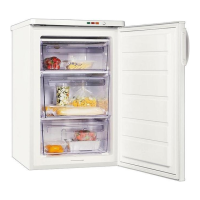
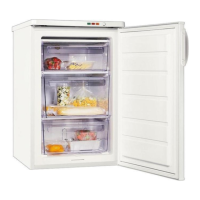
The Zanussi ZFG06400WA is a domestic freezer designed specifically for the storage of edible foodstuffs. It operates by maintaining a low temperature, typically -18°C (-0.4°F) or colder, to preserve frozen food for extended periods, generally up to 3 months, though specific storage times should adhere to manufacturer recommendations on food packaging. The freezer is equipped with a 4-star frozen food compartment, indicating its capability for long-term storage and freezing fresh food. The appliance is designed to operate in ambient temperatures between 16°C and 38°C. If ambient temperatures fall outside this range for prolonged periods, the freezer may not operate correctly, potentially leading to food spoilage.
The freezer's operation is controlled by a thermostat located on the control panel. Users can adjust the temperature setting from "Min" (Cold) to "Normal" (Colder, the recommended default setting) to "Max" (Coldest). The optimal temperature setting can be influenced by factors such as room temperature, frequency of door openings, amount of food stored, and the appliance's position. It is recommended to allow the appliance to stand for 2 hours after installation before plugging it in and switching it on. After turning it on, the freezer should run for approximately 4 hours to reach the correct temperature before food is placed inside.
For freezing fresh food, it should be placed on the top freezer shelf. The freezing process aims to reduce the food's temperature quickly to minimize ice crystal formation, which helps preserve food quality upon defrosting. Frozen food should not be refrozen once it has thawed. Carbonated or fizzy drinks should not be placed in the freezer as they can cause containers to explode. Ice lollies should not be consumed directly from the freezer to avoid "frost/freezer burns."
The freezer has a net storage volume of 68 liters. When storing commercially frozen food, it should be placed in the freezer as soon as possible after purchase, following the manufacturer's instructions. Opened packets of frozen food should be rewrapped in airtight materials to prevent "freezer burn" or surface evaporation. Accidentally thawed frozen food should either be used immediately or discarded, especially items like ice cream. Fruits and vegetables, if soft after thawing, should be cooked. Bread and cakes can generally be refrozen without danger. Shellfish and cooked dishes should be refrigerated and used quickly. Large pieces of meat can be refrozen if ice crystals remain, while small joints should be cooked before re-freezing. Chicken should be cooked and re-frozen as a fresh dish.
To conserve energy, the appliance should not be installed near heat sources and should be in a cool, well-ventilated room with good air circulation. Foodstuffs should be packed in airtight packages to prevent unnecessary frosting. Warm food should be allowed to cool down to room temperature before being placed in the freezer. Thawing frozen food in the fridge can also help reduce the refrigeration unit's workload. Keeping the door open for extended periods should be avoided as it increases energy consumption.
In the event of a power failure, the freezer door should be kept closed to maintain the internal temperature for as long as possible. If the temperature rises, the condition of the food should be checked before refreezing.
Before any cleaning or maintenance, the appliance must be disconnected from the electricity supply.
Internal Cleaning: The interior and accessories should be cleaned with lukewarm water mixed with a small amount of bicarbonate of soda (5ml to 0.5 litre of water). Soaps or detergents should be avoided as their smell may linger. The appliance should be rinsed and thoroughly dried afterward. Sharp instruments should not be used to scrape off frost or ice.
External Cleaning: The outer cabinet can be cleaned with warm soapy water. Abrasive products should not be used. Care should be taken when cleaning the underside of the product due to sharp edges. The compressor at the back of the appliance should be dusted once or twice a year with a brush or vacuum cleaner to prevent dust accumulation, which can affect performance and increase electricity consumption.
Defrosting the Freezer: To defrost, any food should be wrapped in layers of newspaper or blankets. The appliance should be switched off at the wall socket and unplugged. The freezer door should be opened, and a suitable container placed to collect defrosting water. After defrosting, the interior should be cleaned and dried. The appliance can then be switched back on, and frozen food replaced. Defrosting can be accelerated by placing bowls of hot (not boiling) water in the freezer and using a plastic scraper to loosen frost. If the temperature of frozen food rises during defrosting, its storage life may be shortened.
When Not in Use: For long periods of disuse, the appliance should be disconnected from the electricity supply, emptied of all food, cleaned, and the door left ajar to prevent unpleasant smells.
Door Reversibility: The door's opening side can be changed from left to right (as supplied) if required by the installation site. This procedure involves removing screws, hinges, and plugs, carefully lifting and repositioning the door, and then reassembling the components. It is crucial that the appliance is disconnected from the mains before attempting this.
Electrical Connection: The appliance must be earthed. Any electrical work should be carried out by a qualified electrician. The mains lead wires are color-coded (Green and Yellow for Earth, Brown for Live, Blue for Neutral) and should be connected to the corresponding terminals in the plug. The cord clamp must be secure, and the electricity supply voltage should match the appliance's rating plate. The appliance is supplied with a 13 amp plug, and if the fuse needs changing, a 13 amp ASTA approved (BS 1362) fuse must be used. Inserting a cut-off plug into a 13 amp socket is a serious safety hazard.
 General
| Energy efficiency scale | A to G |
|---|---|
| Annual energy consumption | 200 kWh |
| Thermostat | Yes |
| Noise level | 43 dB |
| Star rating | 4* |
| Freezing capacity | - kg/24h |
| Freezer gross capacity | 70 L |
| Door hinge | Right |
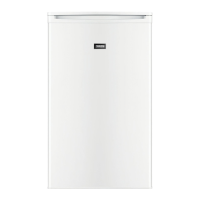
| Product type | Upright freezer |
| Product color | White |
| Built-in display | No |
| Appliance placement | Freestanding |
| Freezer number of shelves/baskets | 3 |
 Weight and Dimensions
| Width | 494 mm |
|---|---|
| Height | 847 mm |
| Weight | 29000 g |

 To Next Page