Inflation
--
Tire
Pressure
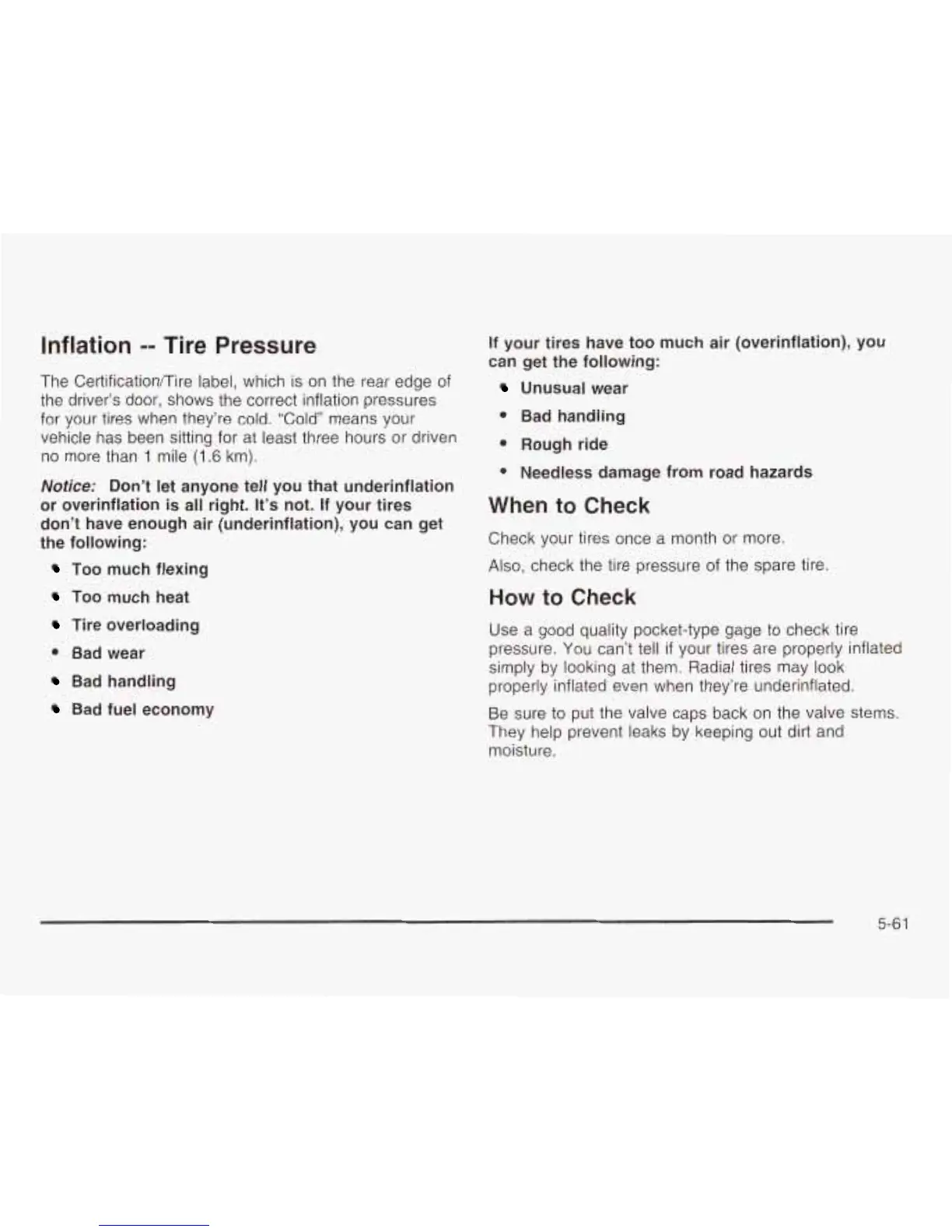
The Certificationrrire label, which is on the rear edge of
the driver’s door, shows the correct inflation pressures
for your tires when they’re cold. “Cold” means your
vehicle has been sitting for at least three hours or driven
no more than
1
mile
(1.6
km).
Notice:
Don’t let anyone tell you that underinflation
or overinflation is all right. It’s not. If your tires
don’t have enough air (underinflation), you can get
the following:
Too
much flexing
Too
much heat
Tire overloading
0
Bad wear
Bad handling
Bad fuel economy
If
your tires have too much air (overinflation), you
can get the following:
Unusual wear
0
Bad handling
0
Rough ride
0
Needless damage from road hazards
When
to
Check
Check your tires once a month or more.
Also,
check the tire pressure of the spare tire.
How
to
Check
Use
a good quality pocket-type gage to check tire
pressure. You can’t tell
if
your tires are properly inflated
simply by looking at them. Radial tires may look
properly inflated even when they’re underinflated.
Be sure
to
put the valve caps back on the valve stems.
They help prevent leaks by keeping out dirt and
moisture.
5-61


 To Next Page
 Loading...