EasyManua.ls Logo

Ford Thunderbird 1958 - Ignition Timing; Distributor Tests, Adjustments, and Minor Repairs; Spark Advance Control Mechanism

Ford Thunderbird 1958
63 pages
Print Icon
To Next Page IconTo Next Page
To Previous Page IconTo Previous Page
Loading...
PART
2
IGNITION
SYSTEM
1-49
3
B.T.C.
CONVENTIONAL
DRIVE
AND
OVERDRIVE
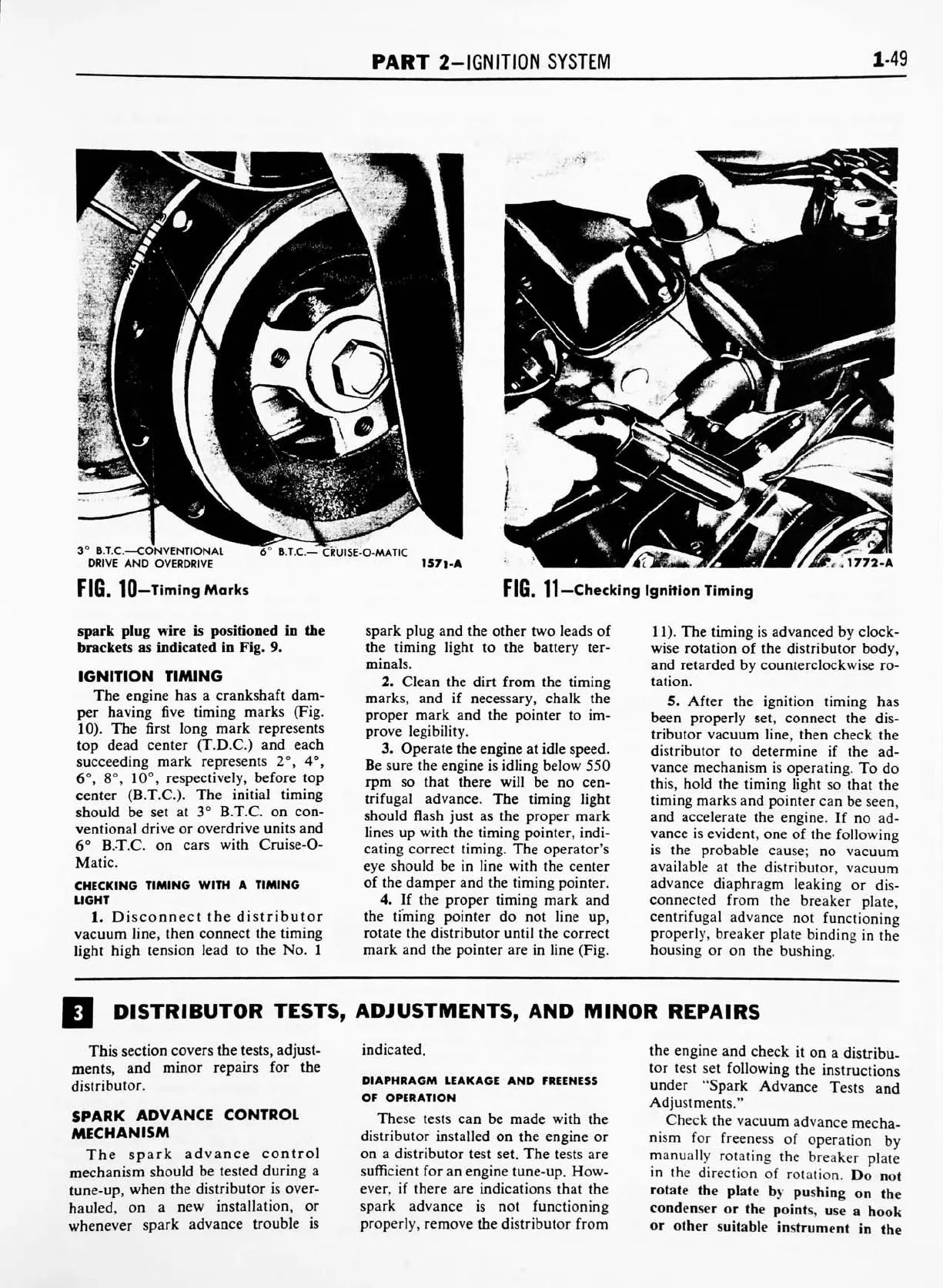
FIG.
10
Timing
Marks
spark
plug
wire
is
positioned
in
the
brackets
as
indicated
in
Fig.
9.
IGNITION
TIMING
The
engine
has
a
crankshaft
dam
per
having
five
timing
marks
(Fig.
10).
The
first
long
mark
represents
top
dead
center
(T.D.C.)
and
each
succeeding
mark
represents
2,
4,
6,
8,
10,
respectively,
before
top
center
(B.T.C.).
The
initial
timing
should
be
set
at
3
B.T.C.
on
con
ventional
drive
or
overdrive
units
and
6
B.T.C.
on
cars with
Cruise-O-
Matic.
CHECKING
TIMING
WITH
A TIMING
LIGHT
1.
Disconnect
the
distributor
vacuum
line,
then
connect
the
timing
light
high
tension
lead
to
the
No.
1
6
B.T.C
CRUISE-O-MATIC
1571-A
FIG.
11
Checking
Ignition
Timing
<
,1772-A
spark
plug
and
the
other
two
leads
of
the
timing
light
to
the
battery
ter
minals.
2.
Clean
the
dirt
from
the
timing
marks,
and
if
necessary,
chalk
the
proper
mark
and
the
pointer
to
im
prove
legibility.
3. Operate
the
engine
at
idle
speed.
Be
sure
the
engine
is
idling
below
550
rpm
so
that
there
will
be
no
cen
trifugal
advance.
The
timing
light
should
flash
just
as
the
proper
mark
lines
up
with
the
timing
pointer,
indi
cating
correct
timing.
The
operator's
eye
should
be
in
line
with
the
center
of
the
damper
and
the
timing
pointer.
4.
If
the
proper
timing
mark
and
the
timing
pointer
do
not
line
up,
rotate
the
distributor
until
the
correct
mark
and
the
pointer
are
in
line
(Fig.
11).
The
timing
is
advanced
by
clock
wise
rotation
of
the
distributor
body,
and
retarded
by
counterclockwise
ro
tation.
5.
After
the
ignition
timing
has
been
properly
set,
connect
the
dis
tributor
vacuum
line,
then
check
the
distributor
to
determine
if
the
ad
vance
mechanism
is
operating.
To
do
this,
hold
the
timing
light
so
that
the
timing
marks
and
pointer
can
be
seen,
and
accelerate
the
engine.
If
no
ad
vance
is
evident,
one
of
the
following
is
the
probable
cause;
no
vacuum
available
at
the
distributor,
vacuum
advance
diaphragm
leaking
or
dis
connected
from
the
breaker
plate,
centrifugal
advance
not
functioning
properly,
breaker
plate
binding
in
the
housing
or
on
the
bushing.
DISTRIBUTOR
TESTS,
ADJUSTMENTS,
AND
MINOR
REPAIRS
This
section
covers
the
tests,
adjust
ments,
and
minor
repairs
for
the
distributor.
SPARK
ADVANCE
CONTROL
MECHANISM
The
spark
advance
control
mechanism
should
be
tested
during
a
tune-up,
when
the
distributor
is
over
hauled,
on
a
new
installation,
or
whenever
spark
advance
trouble
is
indicated.
DIAPHRAGM
LEAKAGE
AND
FREENESS
OF
OPERATION
These
tests
can
be
made
with
the
distributor
installed
on
the
engine
or
on
a
distributor
test
set.
The
tests
are
sufficient
for
an
engine
tune-up.
How
ever,
if
there
are
indications
that
the
spark
advance
is
not
functioning
properly,
remove
the
distributor
from
the
engine
and
check
it
on
a
distribu
tor
test
set
following
the
instructions
under
"Spark
Advance
Tests
and
Adjustments."
Check
the
vacuum
advance
mecha
nism
for
freeness
of
operation
by
manually
rotating
the
breaker
plate
in
the
direction
of
rotation.
Do
not
rotate
the
plate
by
pushing
on
the
condenser
or
the
points,
use
a
hook
or
other
suitable
instrument
in
the

Table of Contents

Related product manuals