Need help?
Do you have a question about the Icom IC-M35 and is the answer not in the manual?
 General
| Brand | Icom |
|---|---|
| Model | IC-M35 |
| Category | Transceiver |
| Language | English |
Key instructions and warnings for safe operation of the transceiver.
Defines hazard symbols like DANGER, WARNING, CAUTION, and NOTE.
Details the transceiver's ability to float and associated considerations.
Explains noise detection and volume boost for clear communication.
Describes the sub-microphone's function in reducing ambient noise.
Instructions for using Channel 16 for distress calls.
Step-by-step guide for making a distress call.
Procedure and importance of cleaning after saltwater exposure.
Warning against short-circuiting battery terminals.
Warning about using only Icom-approved battery packs and chargers.
Warning about connecting to AC outlets, risk of shock/fire.
Safety guideline regarding antenna proximity to body during transmission.
Caution about attaching antenna and battery pack securely and dry.
Warning against using non-specified power sources.
Operating temperature limits and sunlight warning.
Warning against using harsh solvents for cleaning.
Instruction to only use PTT when transmitting.
Warning against modifying the transceiver due to warranty void.
Prohibition of use in explosive atmospheres.
Safety instruction to keep the device away from children.
Warning about keeping the transceiver away from magnetic compasses.
Warning about the transceiver's right-side panel getting hot.
Information on IPX7 waterproof rating and its limitations after dropping.
Instruction to power off before connecting/disconnecting accessories.
Rules concerning priorities for safety and distress calls.
Guidelines regarding the privacy of overheard communications.
Information on ship station and operator licenses.
Information on obtaining a ship station license.
Details about the restricted radiotelephone operator permit.
Lists and shows the standard accessories included with the transceiver.
Instructions for attaching and using the handstrap for carrying.
Instructions for attaching and detaching the belt clip.
Lists and shows the attachments for the transceiver.
Instructions for connecting the flexible antenna.
Instructions for removing and attaching the battery pack.
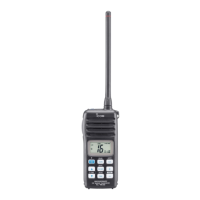
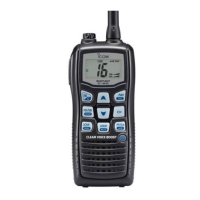
Identifies and describes the physical controls and connectors.
Location and function of the antenna connector.
Details the external speaker-microphone connector and cap usage.
Explains the function of the Push-To-Talk switch.
Describes the function of the Channel 16 key.
Explains how to adjust volume, squelch, and activate monitor function.
Describes functions related to scanning and dual/tri-watch modes.
Explains how to change channels and navigate menus.
Details functions for selecting and tagging favourite channels.
Describes how to select channel groups and return to previous channels.
Explains how to change transmit power and activate key lock.
Explains how to turn the transceiver on and off.
Explains how to activate volume loud and mute functions.
Explains the various indicators and readouts on the transceiver's display.
Indicates when the transceiver is transmitting.
Shows when a signal is being received or squelch is open.
Appears when a TAG channel is selected.
Appears when the call channel is selected.
Appears when the key lock function is activated.
Shows the remaining battery power level.
Indicates when the scan function is active.
Shows DUAL or TRI status during respective modes.
Appears when a duplex channel is selected.
Displays channel number, set mode items, volume, or squelch level.
Shows the current squelch level.
Displays the current volume level.
Blinks during volume adjustment or noise detection.
Blinks during squelch level adjustment.
Shows the selected channel number or set mode values.
Indicates the currently selected channel group.
Appears when the ATIS channel group is selected.
Indicates when low power mode is selected.
How to select channels, including Channel 16 and call channels.
Importance and use of Channel 16 for distress and initial contact.
How to use and program call channels for quick recall.
Details on selecting different channel groups (USA, Intl, CAN, ATIS).
Step-by-step guide to receiving and transmitting signals.
Detailed steps to program custom call channels.
How to adjust the volume using specific keys.
How to activate and deactivate the volume loud feature.
How to activate and deactivate the volume mute feature.
Steps to adjust the squelch for optimal reception.
How to lock and unlock the transceiver keys.
How to open the squelch temporarily to listen.
How to activate and deactivate automatic display backlighting.
How to activate the water clearing function for the speaker.
Explains Priority and Normal scan modes.
How to add or remove channels from the scan list.
Steps to initiate priority or normal scan.
Explains the functions of Dualwatch and Tri-watch.
Steps to start and cancel Dualwatch/Tri-watch.
Overview of settings adjustable in Set Mode.
Steps to enter, navigate, and exit Set Mode.
Details on various adjustable settings like Beep tone, Priority scan, etc.
How to set the beep tone for key presses.
How to enable priority scanning.
How to configure the scan resume timer.
How to enable automatic scanning.
How to set the Dual/Tri-watch mode.
How to configure the monitor key behavior.
How to activate and deactivate automatic display backlighting.
How to adjust the LCD contrast.
How to enable and configure power saving.
How to adjust squelch sensitivity for noise rejection.
How to set the low fix function for output power.
How to enable and adjust noise detection.
Warnings and precautions for handling Lithium-Ion batteries.
Warning against physical impact or damage to the battery.
Warning about high temperatures causing battery rupture or fire.
Warning against exposing the battery to liquids.
General warning to keep battery packs away from fire hazards.
Warning against soldering or modifying battery terminals.
Warning to use batteries only with specified equipment.
Safety warning about battery fluid contact with eyes.
Warning about abnormal battery conditions like odor or discoloration.
Instruction for washing skin contact with battery fluid.
Warning against heating batteries in microwaves or induction cookers.
Cautions regarding charging the battery pack.
Warning against charging in high-temperature environments.
Warning against charging during thunderstorms due to shock/fire risk.
Warning about charging batteries beyond the specified time.
Warning about charging wet or soiled transceivers.
Caution about charging temperature limits.
Instructions for connecting the supplied battery charger.
Information about the optional AAA battery case.
Instructions for installing the BC-162 charger.
Steps for charging using the BC-162 charger.
Details the features and parts of the HM-165 speaker-microphone.
Instructions for connecting the speaker-microphone.
List of international VHF marine channels and frequencies.
List of USA VHF marine channels for specific regions.
List of Canadian VHF marine channels for China version.
General specifications including frequency, mode, and power.
Receiver specifications like sensitivity and selectivity.
Transmitter specifications like output power and modulation.
Details about optional battery cases and packs.
Information on optional battery chargers.
Information about the optional belt clip.
Lists other available optional accessories.
List of country codes according to ISO 3166-1.
Instructions for proper disposal of electronic products and batteries.

 To Next Page