EasyManua.ls Logo

Furuno 1830 - Collision Avoioance

Furuno 1830
66 pages
Print Icon
To Next Page IconTo Next Page
To Previous Page IconTo Previous Page
Loading...
COLLISION
AVOIDANCE
ColHsions
at
sjoa
somotime'^
oceur
becouse
the
radar*
piclui'G
doean't
molch
Ihe
information
providcd
by
Ihe
eye
in
clear
wealher
and
because
of
the
misunderslanding
of
relative
motion.
In
a
relative
motion
display
your
ship
is
represented
by
the
spot
of
light
l'ixed
at
the
center
of
the
screen,
whatever
the
speed
of
your
own
ship.
With
both
your
own
ship
and
the
target
in
motion,
the
successive
pips
of
the
target
do
not
indicatc
the
actual
or
true
movement
of
tlie
target.
If
own
ship
is
in
motion,
the
pips
of
fixed
objects,
such
as
landmasses,
move
on
the
display
at
a
rate
equal
to
and
in
a
direction
opposite
to
the
motion
of
own
ship.
Only
when
your
ship
is
stopoed
or
motionless
do
target
pips
move
on
the
display
in
accordance
with
their
true
motion.
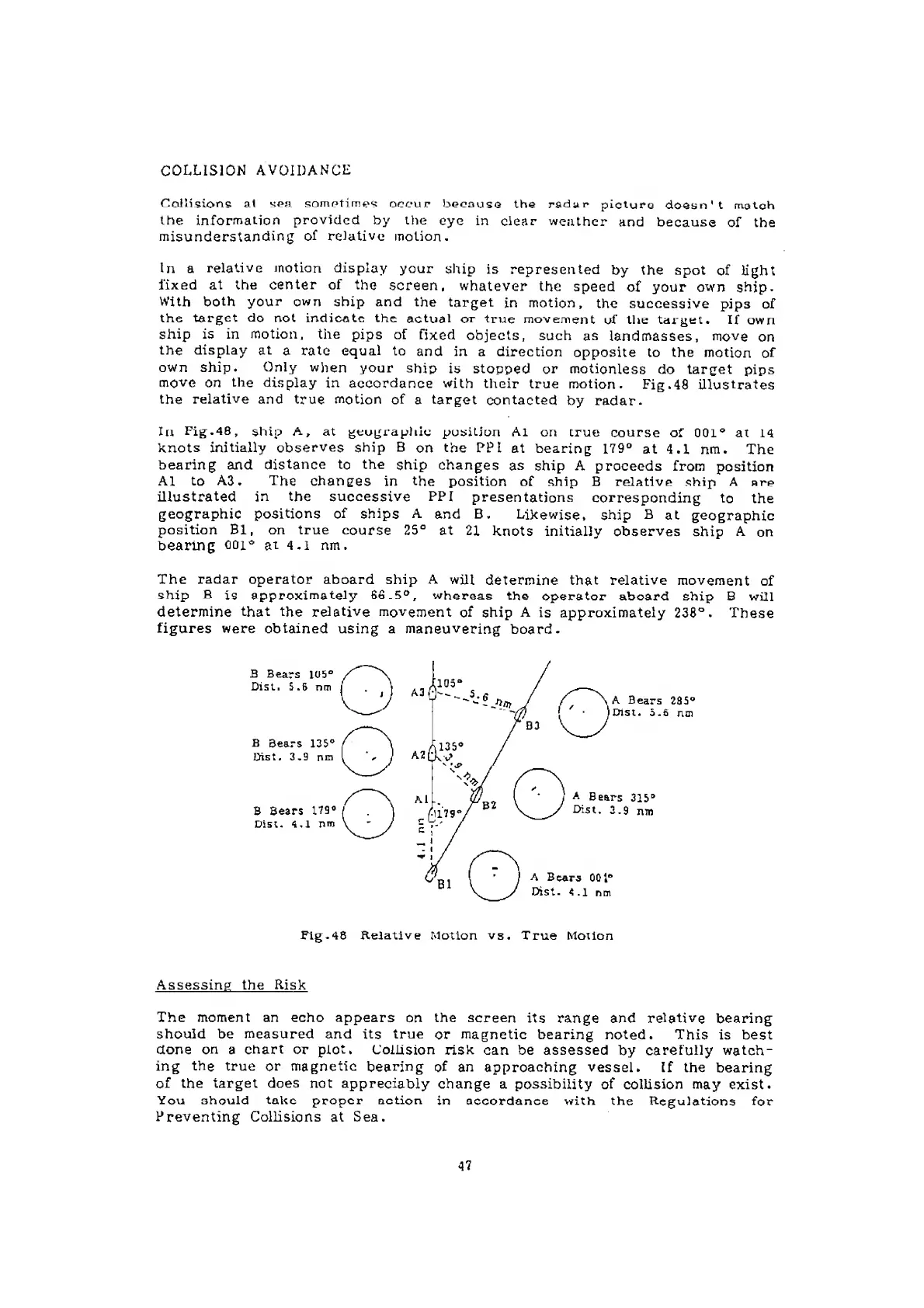
Fig.48
Ulustrates
the
relative
and
true
motion
of
a
target
contacted
by
radar.
In
Fig.48,
ship
A,
at
geugraphic
position
Al
on
true
course
of
001®
at
14
knots
initially
observes
ship
B
on
the
PPI
at
bearing
179°
at
4.1
nm.
The
bearing
and
distance
to
the
ship
changes
as
ship
A
proceeds
from
position
Al
to
A3.
The
changes
in
the
position
of
ship
B
relative
ship
A
nre
illustrated
in
the
successive
PPI
presentations
corresponding
to
the
geographic
positions
of
ships
A
and
B.
Likewise,
ship
B
at
geographic
position
Bl,
on
true
course
25°
at
21
knots
initially
observes
ship
A
on
bearing
ooi®
at
4,i
nm.
The
radar
operator
aboard
ship
A
will
determine
that
relative
movement
of
ship
B
is
approximately
66.5°,
whereas
the
operator
aboard
ship
B
will
determine
that
the
relative
movement
of
ship
A
is
approximately
238°.
These
figures
were
obtained
using
a
maneuvering
board.
Fig.48
Relative
Motion
vs.
True
Motion
Assessing
the
Risk
The
moment
an
echo
appears
on
the
screen
its
range
and
relative
bearing
should
be
measured
and
its
true
or
magnetic
bearing
noted.
This
is
best
done
on
a
chart
or
ptot.
Coilision
nsk
can
be
assessed
by
carefully
watch-
ing
the
true
or
magnetic
bearing
of
an
approaching
vessel.
If
the
bearing
of
the
target
does
not
appreciably
change
a
possibility
of
coilision
may
exist.
You
should
take
proper
action
in
accordance
with
the
Regulations
for
Preventing
Collisions
at
Sea.
47

Related product manuals