EDITING EFFECTS
In addition to amp models, each preset also features various combinations of eects. Eects can be edited in
several ways—they can be bypassed, replaced, moved, added or deleted. Further, the individual settings
of each eect can be modied. Each option is explained below and on the following pages.
Editing the types of eects in use and their position in the signal path happens in the SIGNAL PATH LAYER. To
do this, rst access the SIGNAL PATH LAYER by pressing its corresponding LAYER BUTTON, which will auto-
matically highlight the amplier model in use rst. To highlight an eect, turn the ENCODER in either direc-
tion (see illustrations below). The eect will be highlighted with a white arrow below it and a label above it.
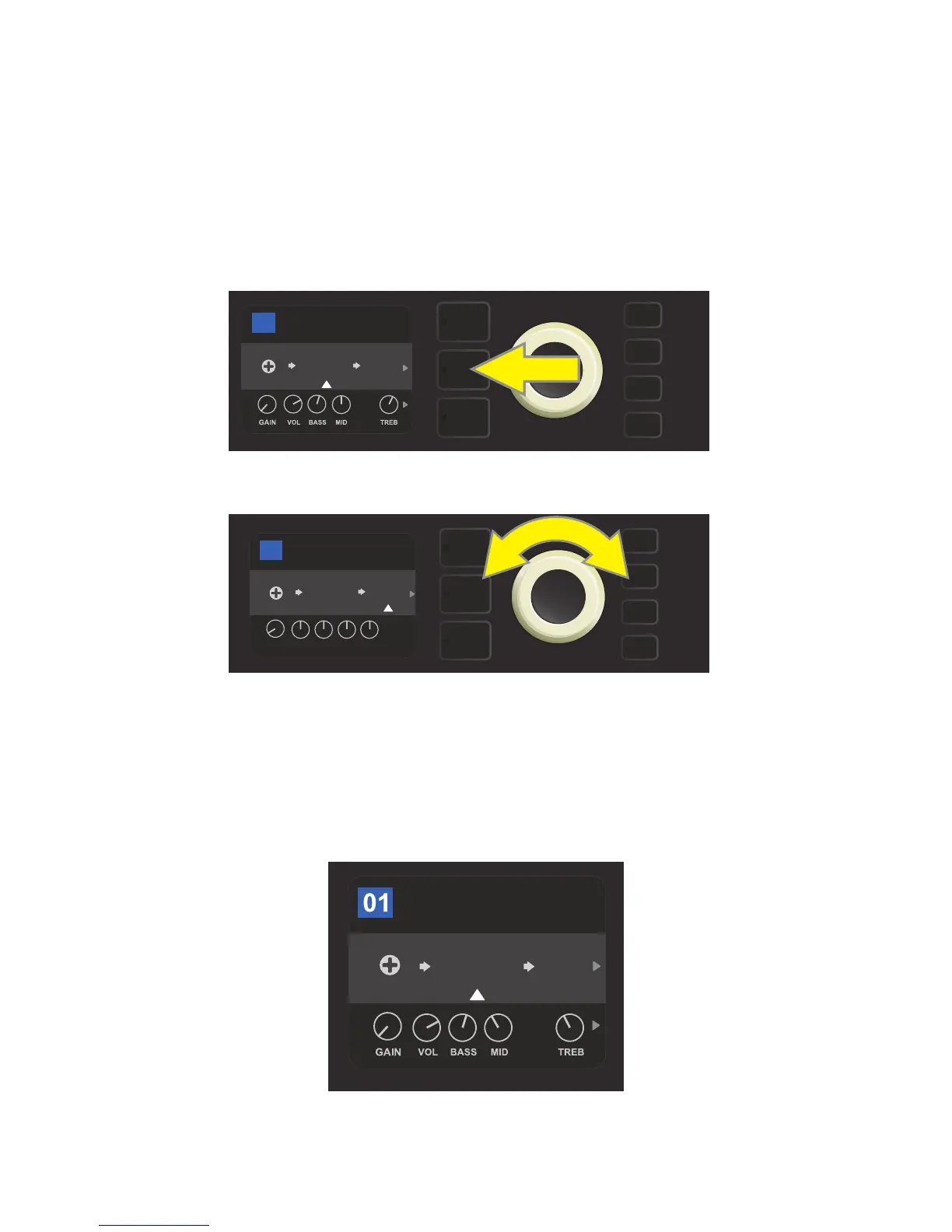
For each preset, note that a placeholder symbol consisting of a plus sign (+) in a circle appears at the right and
left ends of the SIGNAL PATH LAYER (see illustration below). This symbol indicates an open slot into which an ef-
fect can be moved or added (see “Adding an Eect,” page 22). In many presets that include one or more eects,
the user must scroll to the far right or far left using the ENCODER in order to see this symbol.
To access eects, rst press the middle LAYER BUTTON to enter SIGNAL PATH LAYER.
Turn the ENCODER in either direction to highlight an eect (as indicated
here by the white arrow below it and label above it).
18
Close-up detail of a dierent preset that includes an open slot in which an eect can be placed, marked here by a place-
holder symbol (a plus sign in a circle) at the far left end of the SIGNAL PATH LAYER.
BASIC RUMBLE V2
SMALL
ROOM
RUMBLE
V2
AMPLIFIER
17
FREQ
1494
Hz
SMALL
ROOM
RUMBLE
V2
AMPLIFIER
17
TYPE
POST
POST FX 1
BASIC RUMBLE V2
LVL DCAY DWLL DIFF TONE
AMPLIFIER
FREQ
SUPER
BMAN-OD
BASIC BASSMAN CL
1000
SMALL
ROOM


 To Next Page
 Loading...