Service - 30
CHECKING HYDRAULIC OIL LEVEL
Check hydraulic oil level before operating unit when
the hydraulic system is cold. If the hydraulic sys-
tem is warm, allow 1 hour for the hydraulic system
to cool before checking. If the hydraulic system is
warm when the oil level is checked, it will produce
an inaccurate oil level reading.
1. Park power unit on a level surface.
2. Engage parking brake and shut off engine.
3. Remove ignition key from switch and allow time
for hydraulic system to cool.
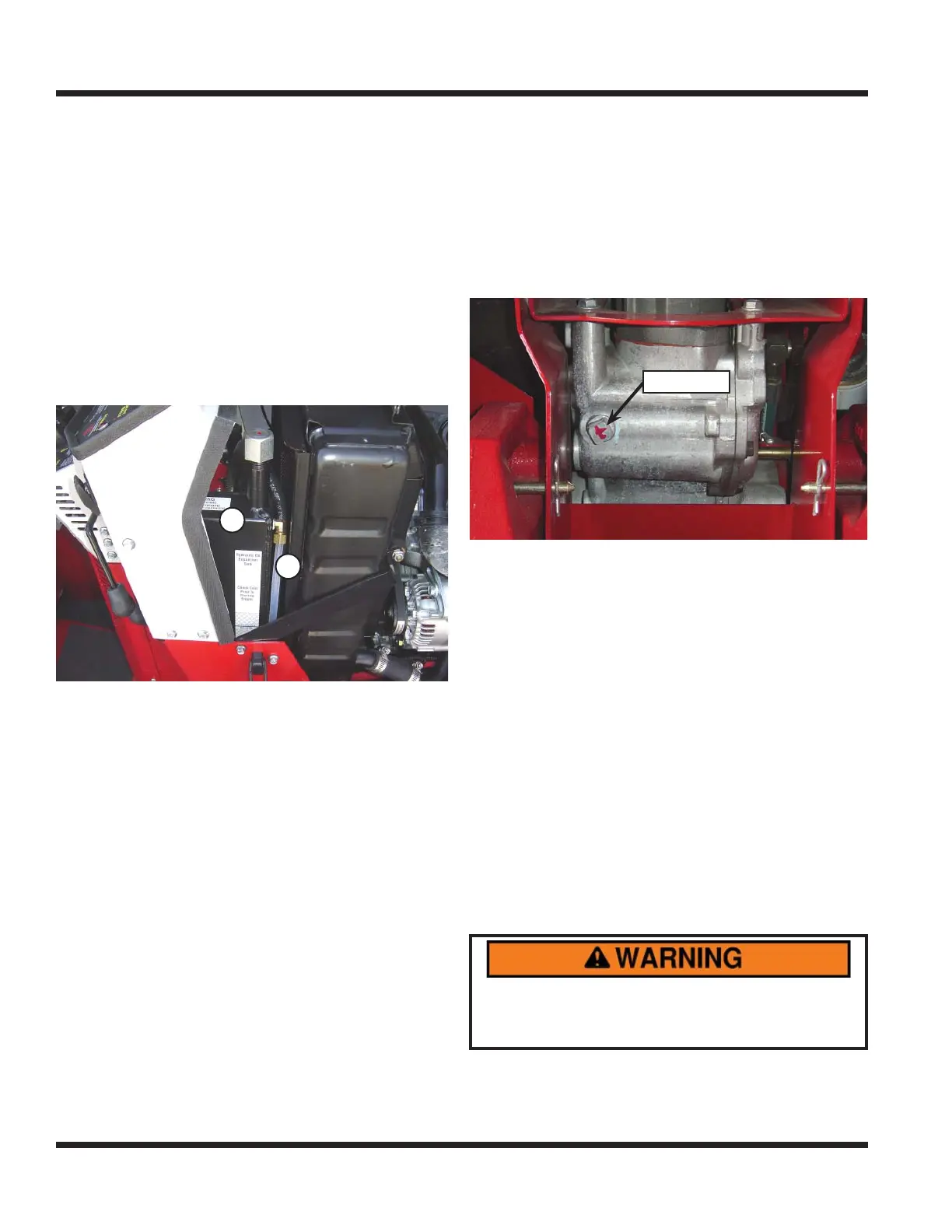
4. The hydraulic tank is located under the hood
near the right side of the dash as shown. (A)
5. Check that the
A
B
oil level in the plastic sight tube
(B) next to the hydraulic tank is within the proper
range indicated by the oil level decal.
6. If hydraulic oil level is below the checkered area
of the decal, add HydroTorq XL synthetic hydrau-
lic oil until the proper level is reached.
CHECKING REAR TRANSAXLE OIL
Check the rear transaxle oil level before operating
unit when oil is cold.
1. Park power unit on a level surface.
2. Engage parking brake and shut off engine.
3. Remove the oil fi ll plug from the transaxle and
check to see if oil is even with the bottom of the
oil fi ll hole.
4.
Oil Fill Plug
If oil level is low, add HydroTorq XL synthetic
hydraulic oil until level with bottom of oil fi ll hole.
CHANGING HYDRAULIC OIL AND FILTER
Hydraulic oil and fi lters should be changed at in-
tervals of 2000 hours. Hydraulic oil and fi lters to be
changed by an authorized Ventrac dealer only.
SERVICING CLOSED LOOP HYDROSTATIC DRIVE
C
IRCUIT
Service or repair must be performed by an autho-
rized Ventrac dealer.
If any part of the closed loop hydrostatic drive circuit
(pump, front drive motor, rear drive motor, or any
of the three 1/2” hydraulic lines connecting them
together) is serviced or replaced, the Ventrac closed
loop drive circuit fi ltration procedure must be per-
formed. This procedure requires a special Ventrac
remote fi ltering tool and must be performed by a
Ventrac authorized technician.
Failure to perform this fi ltering procedure
following a repair can result in component and/or
complete system failure and may void warranty.
SERVICE


 To Next Page
 Loading...