17
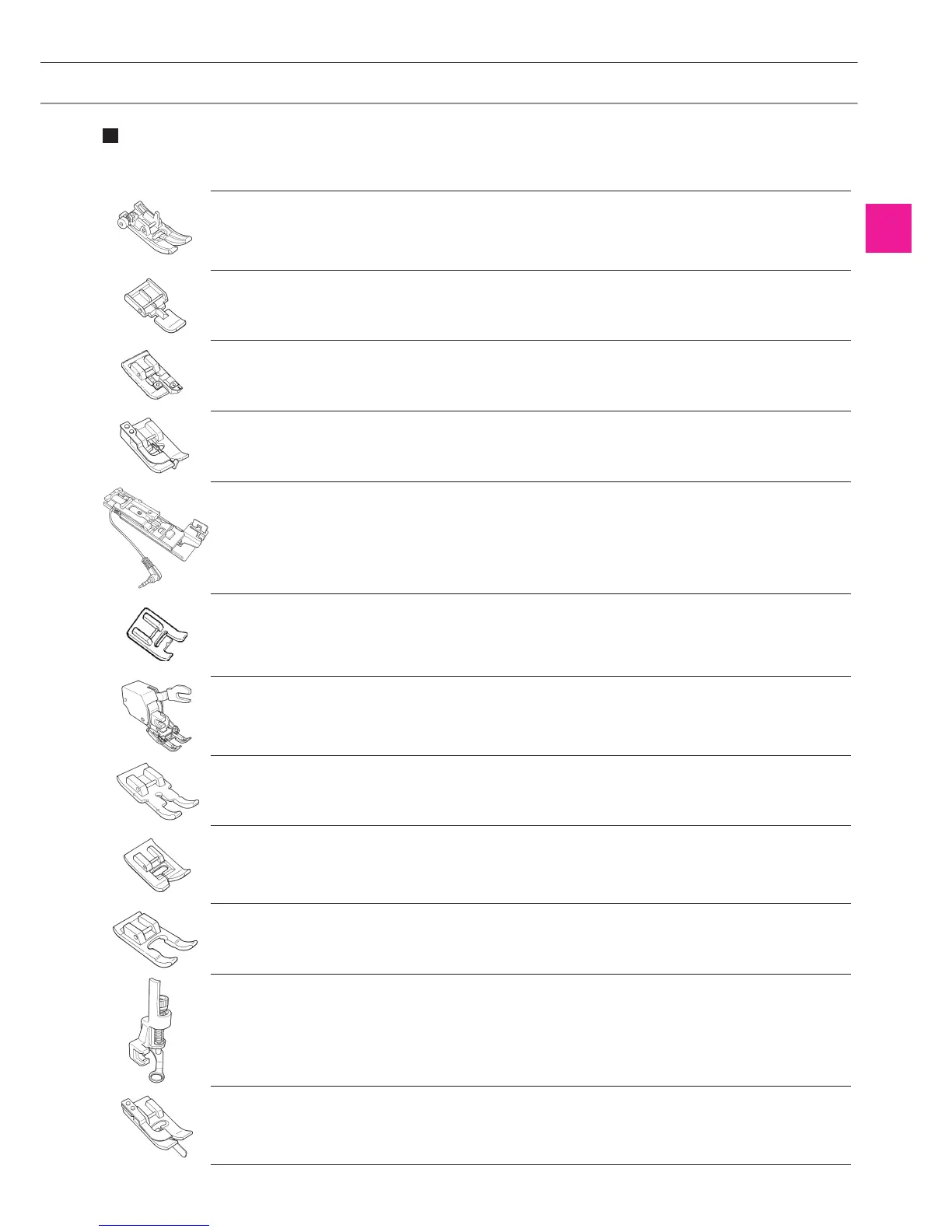
The type and application of the presser foot
Standard presser
foot
A
This is used mainly for straight stitch and zigzag stitches.
Use this presser foot especially when sewing heavy-weight
materials.
Zipper presser foot B
This is used to attach zippers.
Overcasting presser
foot
C
This presser foot is used exclusively for overcasting to prevent
the cut edge of fabrics from fraying.
Blind stitch presser
foot
D
This presser foot is used for blind stitch on hems of trousers
and skirts, or sleeves.
Buttonhole presser
foot
E
This presser foot is used for automatic buttonholing.
Manual buttonhole
presser foot
I
This is used for sewing decorative stitches, letters and bartacks.
Also for manual buttonhole (pattern No. 03).
Walking foot N
In general, this presser foot is used for difcult-to-feed” materi-
als such as knits, jersies, vinyl, articial leather and leather or
quilting.
Patchwork presser
foot
P
This presser foot is used for patchwork stitches. There are two
seam lines, 1/4-inch and 1/8-inch from center needle position.
Smooth presser
foot
T
This presser foot is used for non-slippery materials like vinyl
and satin stitches.
Open toe presser
foot
O
This is used for the applique and decorative stitches.
(Front part of the presser foot is open for better visibility.)
Quilt presser foot Q
This is used for the quilt stitch.
(Machine setting: Straight Stitch and Center needle position)
Refer to page 74 for more details.
Edge Sewing
presser foot
R
This is used for patchwork, sewing center line of joined
materials by using the center guide of the presser foot.
* Fine tune the needle position by zigzag width adjustment dial.
Marking of presser foot
↓


 To Next Page
 Loading...