2. Intended use
7
The testo 177 data loggers are used to save and read out separate readings and measurement
sequences. The readings are measured, saved and transmitted to a PC, to the testo 575 fast printer
or to the testo 580 data collector per infrared using testo ComSoft software.
Applications
testo 177-T1
Fast and affordable temperature monitoring
in refrigeration and deep freeze sector:
during transport, in refrigerated rooms,
in display cabinets, in containers
Fulfills guidelines in accordance with
EN 12830 standards *
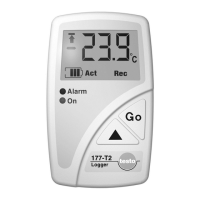
testo 177-T2
Temperature monitoring with display:
during transport, in glass cabinets,
in refrigerated rooms, in containers,
in domestic housing
Fulfills guidelines in accordance with
EN 12830 standards *
testo 177-T3
Temperature logger with display and switch
(door contact) for monitoring transport:
transport monitoring, refrigerated room
monitoring, in containers, in warehouses
Fulfills guidelines in accordance with
EN 12830 standards *
testo 177-T4
Fast measurement of high temperatures:
during production processes, in laboratories
in heating installation sector, in containers
in domestic housing
testo 177-H1
Monitoring of humidity and temperature
values with external temperature and dew
point measurement
in domestic housing, in the pharmaceutical
sector, in museums, in warehouses,
in industry
* In accordance with EN 12830, please ensure that a regular check and calibration in accordance with
EN 13486 (recommendation: once a year) is carried out on this instrument. Please contact us for
more detailed information.
Only for testo 177 - T3
The following components of the product are designed for continuous contact with
foodstuffs in accordance with the regulation
(EG) 1935/2004:
The measurement probe up to 1 cm before the probe handle or the plastic housing. If
provided, the information about penetration depths in the instruction manual or the mark(s)
on the measurement probes should be noted.


 To Next Page
 Loading...