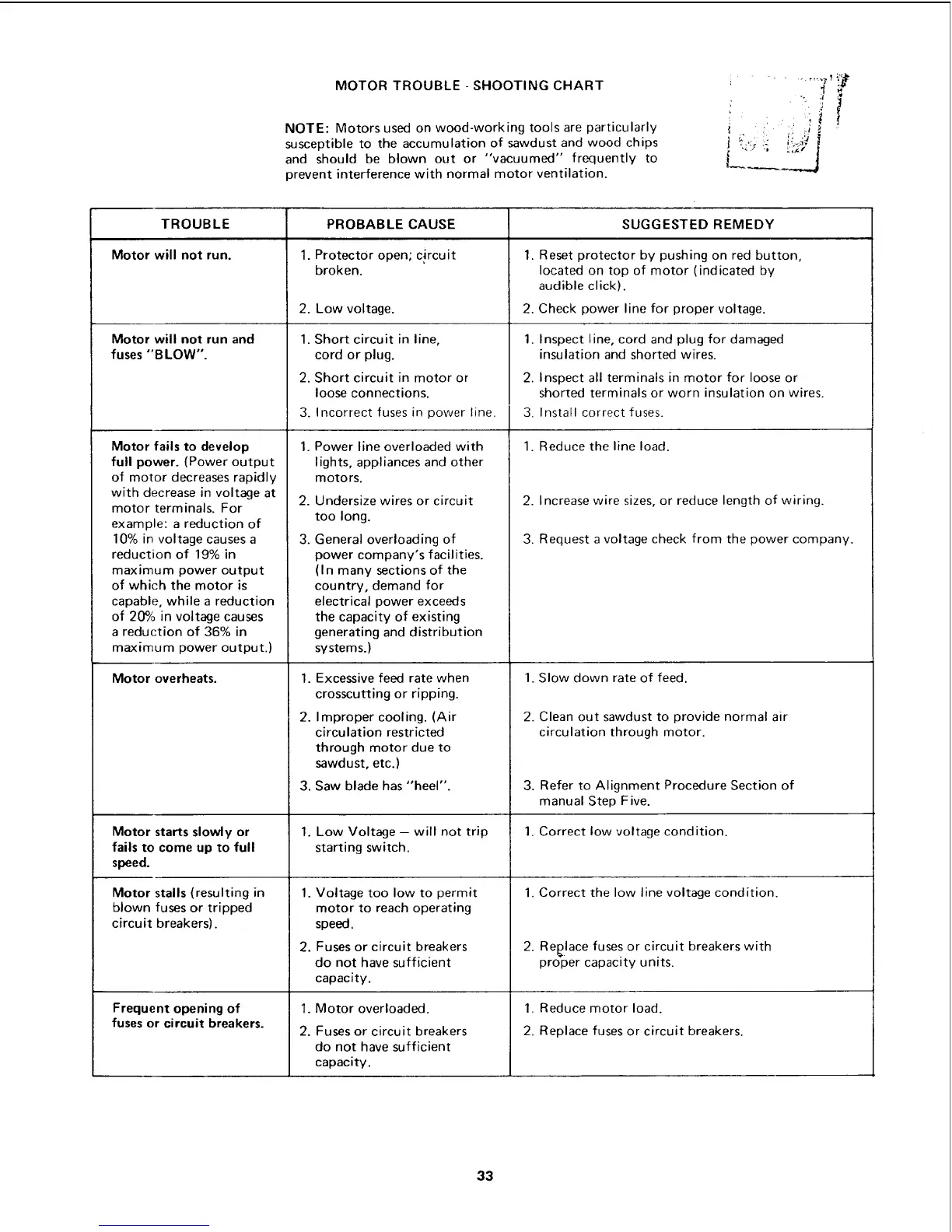
MOTOR TROUBLE - SHOOTING CHART
NOTE: Motors used on wood-working tools are particularly
susceptible to the accumulation of sawdust and wood chips
and should be blown out or "vacuumed" frequently to
prevent interference with normal motor ventilation.
TROUBLE
Motor will not run.
Motor will not run and
fuses "BLOW".
Motor fails to develop
full power. (Power output
of motor decreases rapidly
with decrease in voltage at
motor terminals. For
example: a reduction of
10% in voltage causes a
reduction of 19% in
maximum power output
of which the motor is
capable, while a reduction
of 20% in voltage causes
a reduction of 36% in
maximum power output.)
Motor overheats.
Motor starts slowly or
fails to come up to full
speed.
Motor stalls (resulting in
blown fuses or tripped
circuit breakers).
Frequent opening of
fuses or circuit breakers.
PROBABLE CAUSE
1. Protector open; circuit
broken.
2. Low voltage.
1. Short circuit in line,
cord or plug.
2. Short circuit in motor or
loose connections.
3. Incorrect fuses in power line.
1.
2.
3.
Power line overloaded with
lights, appliances and other
motors.
Undersize wires or circuit
too long.
General overloading of
power company's facilities.
(In many sections of the
country, demand for
electrical power exceeds
the capacity of existing
generating and distribution
systems.)
1. Excessive feed rate when
crosscutting or ripping.
2. Improper cooling. (Air
circulation restricted
through motor due to
sawdust, etc.)
3. Saw blade has "heel".
1. Low Voltage - will not trip
starting switch.
1. Voltage too low to permit
motor to reach operating
speed.
2. Fuses or circuit breakers
do not have sufficient
capacity.
1.
2.
Motor overloaded.
Fuses or circuit breakers
do not have sufficient
capacity.
SUGGESTED REMEDY
1.
Reset protector by pushing on red button,
located on top of motor (indicated by
audible click).
2. Check power line for proper voltage.
1,
2.
3.
Inspect line, cord and plug for damaged
insulation and shorted wires.
Inspect all terminals in motor for loose or
shorted terminals or worn insulation on wires.
Install correct fuses.
1. Reduce the line load.
2. Increase wire sizes, or reduce length of wiring.
3. Request a voltage check from the power company.
1. Slow down rate of feed.
2. Clean out sawdust to provide normal air
circulation through motor.
3. Refer to Alignment Procedure Section of
manual Step Five.
1. Correct low voltage condition.
1. Correct the low line voltage condition.
2. Re_lace fuses or circuit breakers with
proper capacity units.
1. Reduce motor load.
2. Replace fuses or circuit breakers.
33


 To Next Page
 Loading...