561
Driving your vehicle
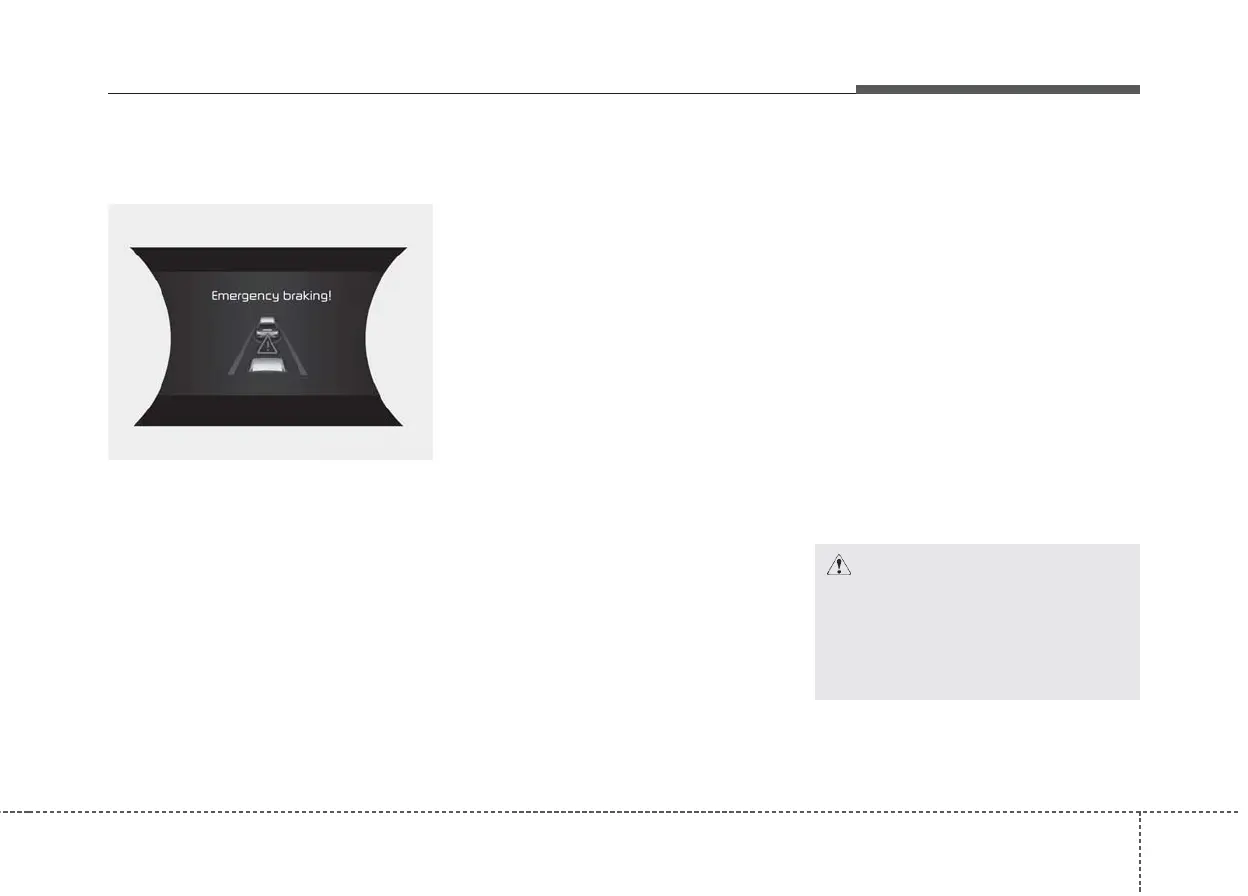
Emergency braking!
(2nd warning)
• The warning message appears on
the LCD display with the warning
alarms.
• The FCA controls the brakes with-
in certain limit to release shock
from the collision.
The FCA controls the maximum
brakes just before the collision.
- If you select "Warning only", the
FCA system activates and pro-
duces only warning alarms in
accordance with the collision risk
levels. You should control the
brake directly because the FCA
system do not control the brake.
• The brake control is maximized
just before a collision, reducing
impact when it strikes a forward
vehicle.
- It will operate if the vehicle speed
is greater than 10 km/h and less
than or equal to 90 km/h on a for-
ward vehicle. (Depending on the
condition of the vehicle ahead
and the environment surrounding
it, the possible maximum operat-
ing speed may be reduced.)
- For pedestrians and cyclists, the
vehicle speed is greater than or
equal to 10 km/h and less than 70
km/h. (Depending on the condi-
tion of pedestrians and bike riders
and the surrounding environment
the possible maximum operating
speed may be reduced.)
Brake operation
• In an urgent situation, the braking
system enters into the ready status
for prompt reaction to assist the driv-
er in depressing the brake pedal.
• The FCA provides additional brak-
ing power for optimum braking per-
formance, when the driver
depresses the brake pedal.
• The braking control is automatical-
ly deactivated, when the driver
sharply depresses the accelerator
pedal, or when the driver abruptly
operates the steering wheel.
• The braking control is automatical-
ly cancelled, when risk factors dis-
appear.
CAUTION
The driver should always pay
great caution to vehicle opera-
tion, even though there is no
warning message or warning
alarm.
ODEEV058201R


 To Next Page
 Loading...