37
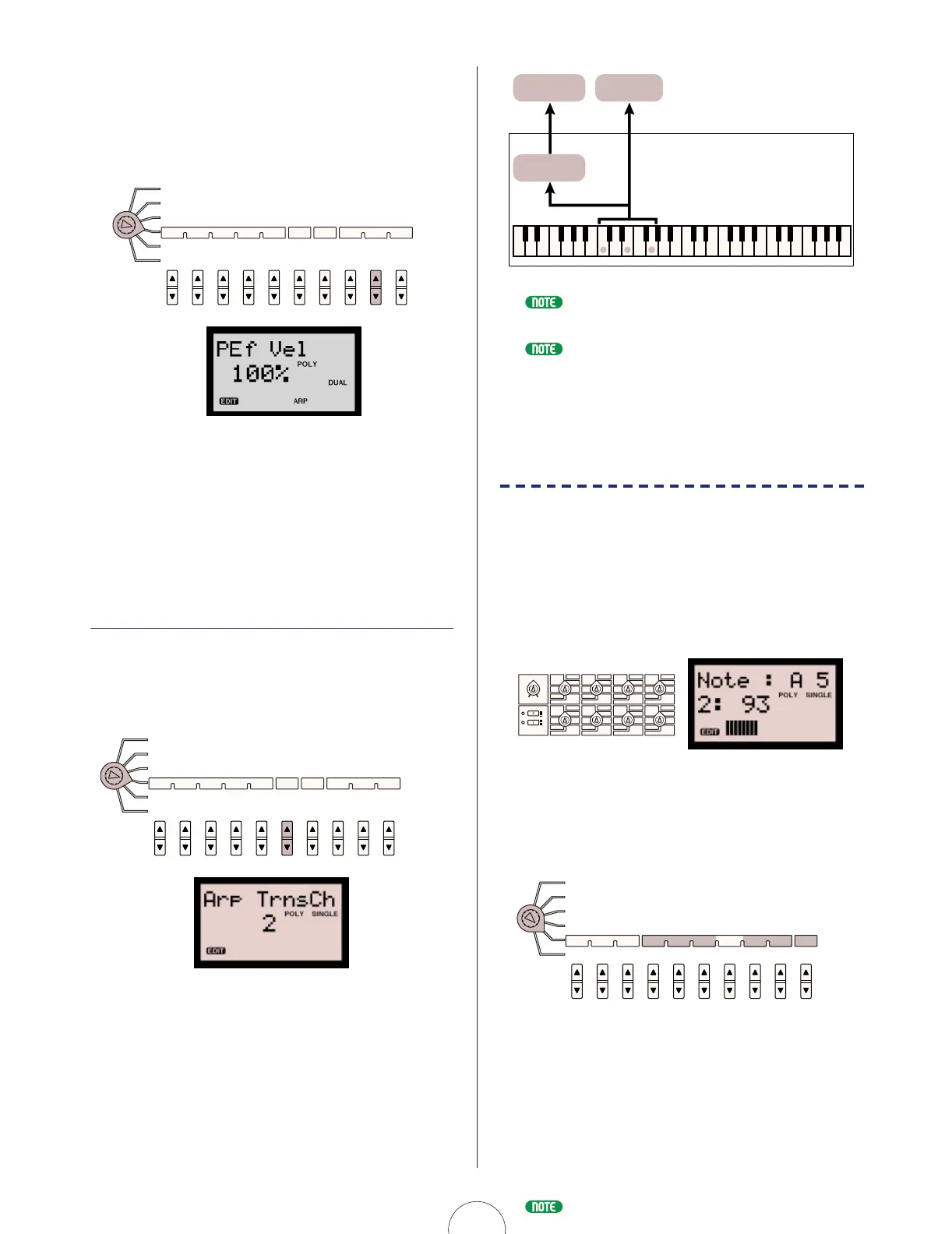
Play Effect Velocity
Press the Play Effect Velocity [UP/DOWN] switch to set
the ratio between the lower and higher velocity values
of the Arpeggiator pattern, over a range between 1%
and 200%.
A setting of “100%” maintains the original velocity
relationship between the notes. Lower values adjust
velocities downward at playback, and higher values
adjust velocities upward at playback. A setting of
“real” (Real-time) will cause the velocity values of the
pattern to be determined by the velocity at which you
play the keyboard.
Arpeggio MIDI Output
You can use the MIDI Pattern Transmit Channel (“PtnTxCh”)
parameter to designate a MIDI channel on which to output
the Arpeggiator pattern data, to either play an external
tone generator or record the data into a MIDI sequencer or
computer.
This setting is independent from the MIDI Transmit Channel
(“MIDI Tx Ch”) setting in the UTILITY SETUP menu (see
page 93), but you can either set them both to the same
channel or different channels, depending on your
requirements. The diagram below shows an example of
how they can be set to different channels to control two
different external tone generators.
Common
Arp/SEQ
Type/No
VOICE
ARPEGGIO/SEQ
KbdMode Hold
SceneSw
MIDI
Ptn Tx Ch
Arpeggio
Subdivide
Play EF
Swing
Velocity
GateTime
Common
Arp/SEQ
Type/No
VOICE
ARPEGGIO/SE
KbdMode Hold
SceneSw
MIDI
Ptn Tx Ch
Arpeggio
Subdivide
Play EF
Swing
Velocity
GateTime
For information about setting the MIDI Pattern Transmit Channel (“MIDI
PtnTxCh”), see page 87.
The MIDI PtnTxCh setting is a system parameter, and will not be saved as voice
data.
Using The Step
Sequencer
The Step Sequencer lets you create your own
16-step looped patterns by setting Note,
Velocity, Gate Time and Control Change event
values for each step (beat) in the sequence using
the CONTROL knobs, where each knob gives
you access to the events in a specific step when
the [EDIT ROTARY] switch is set to the SEQ
EDIT/SETUP menu.
Each of the 128 voices has its own “Voice” Pattern
memory for storing a single sequence. There is also a
separate bank of 128 “User” Patterns. Patterns can be
triggered from the keyboard in a variety of ways.
The specific Step Sequencer-related parameters are
available in the SEQ EDIT/SETUP menu. Also, Pattern
Number, Keyboard Mode, Hold, Scene Switch and Play
Effect parameters in the VOICE ARPEGGIO/SEQ menu
have special functions related to the Step Sequencer. Other
settings which will have a bearing on your sequences
include Tempo and Poly mode settings, and depending on
Layer mode, the Split Point assignment as well.
For information about each SEQ EDIT/SETUP menu parameter, see page 89.
Knob
Event
1-8/9-16
SEQ
EDIT/SETUPStep Hold Length
SEQ
Store
Pattern
Bank
No
BaseUnit
LoopType Ctrl No
VOLUME
CTRL
SCENE
Algorithm
Wave
Attack
Attack
ASSIGN 1 ASSIGN 2
ASSIGN 3
ASSIGN 4
PEG Decay
Wave
VCO1
Fine
Fine
PEG Sw
FM Src2
LFO2 Spd
PmodDepth PmodDepth
Level
LFO1 Wave LFO1 Spd
LFO1 Dly
PW
ASSIGN 5
ASSIGN 6 ASSIGN 7 ASSIGN 8
VCF
Cutoff
Sync
Pmod Sw
Sync Pitch
Pitch Pitch
PEG Depth
Decay
Decay
VCO2
Level
FM Depth
FM Src1
Sync Pitch
Depth
Sustain
Ring
Mod
Sustain
Sync Pitch
Src
Edge
Port Time
Edge
Release
Release
Noise
Level
PW
HPF
Feedback
VCF
PWM Depth
PWM Src PWM Src
PWM Depth
Type
Reso
nance
Volume
FEG
Depth
Fmod
Depth
Amod Depth
Vel
Sens
Key
Track
Vel Sens
Arpeggiator
Ext. TG 2
(Attack sound)
Ext. TG 1
(Pad sound)
Rcv. Ch2
Ptn TxCh2
Rcv. Ch1
MIDI TxCh1


 To Next Page
 Loading...