• Adding the LLC
– Add only water if the mixture reduces in amount
by evaporation.
– If there is a mixture leak, add the LLC of the
same manufacturer and type in the same
mixture percentage.
– Never add any long-life coolant of different
manufacturer. Different brands may contain
different additive components, and the engine
may fail to perform as specified.
• When the LLC is mixed, do not employ any
radiator-cleaning agent. The LLC contains
anticorrosive agent. If mixed with the cleaning
agent, sludge may build up, adversely affecting the
engine parts.
• Service life of Kubota genuine long-life coolant is 2
years. Be sure to change the coolant every 2000
hours or every 2 years whichever comes faster.
*1 At 1.013×10
5
Pa (760 mmHg) pressure (atmospheric). A
higher boiling point is obtained by using a radiator-pressure
cap which permits the development of pressure within the
cooling system.
NOTE :
• The data represents industry standards that
necessitate a minimum glycol content in the
concentrated antifreeze.
SERVICE EVERY 3000 HOURS
1. Checking the supply pump
Consult your local Kubota Dealer for checking the
supply pump.
2. Checking and cleaning the EGR
system
Consult your local Kubota Dealer for checking and
cleaning the EGR system.
SERVICE EVERY 6000 HOURS
1. Cleaning the DPF muffler
Removal of ash
The longer the DPF operates, the more ash (burnt
residue) is collected in the filter. Too much ash build-up
adversely affects the DPF performance.
Consult your local Kubota Dealer to clean the filter.
IMPORTANT :
• The DPF needs to be cleaned with a specific
cleaning device. Do not disassemble the DPF
for cleaning or try to clean it yourself. Consult
your local Kubota Dealer.
SERVICE EVERY 1 YEAR
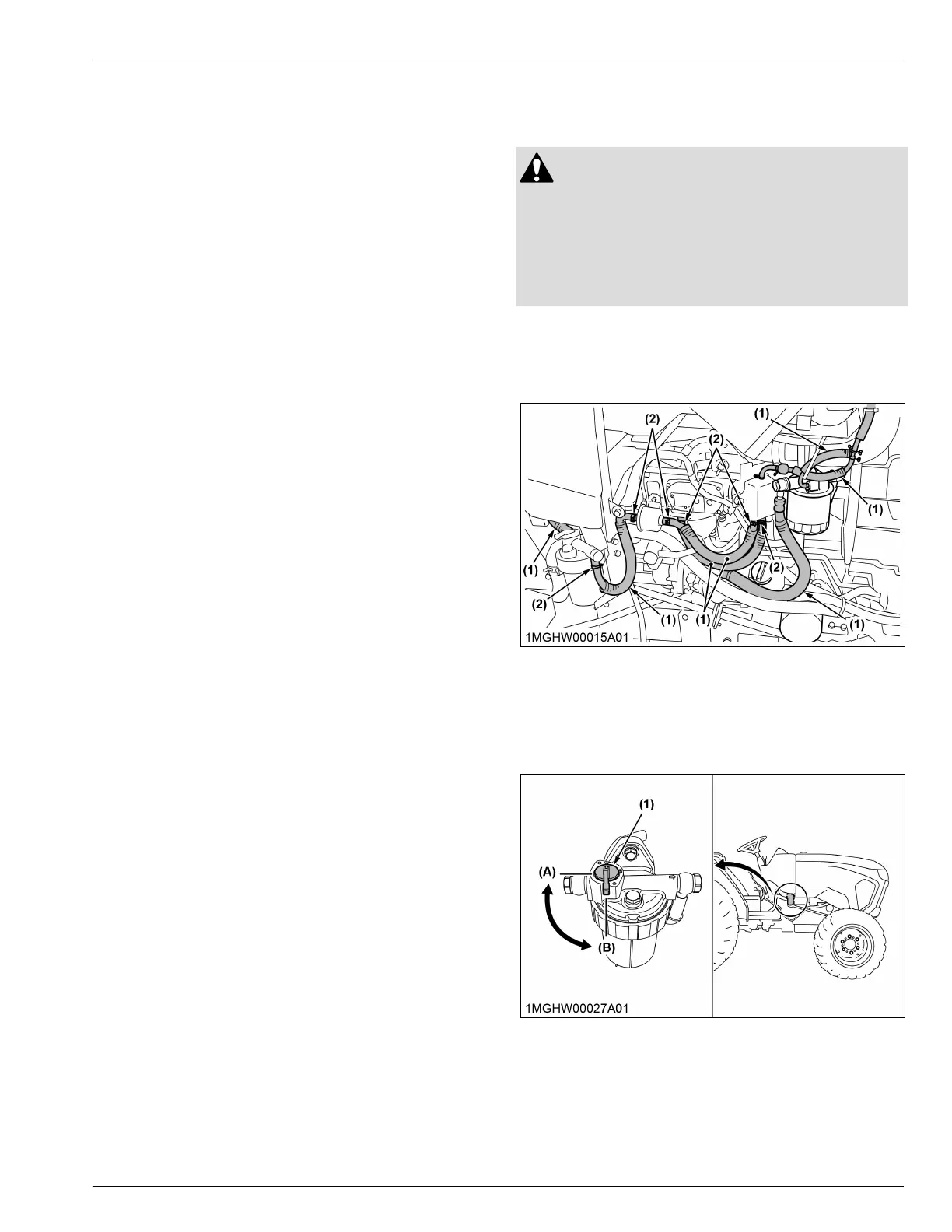
1. Checking the fuel line
WARNING
To avoid personal injury or death:
• Be sure to stop the engine and remove the
starter key before checking the fuel line.
• Check the fuel lines periodically. The fuel lines
are subject to wear and aging. Fuel may leak
out onto the operating engine, causing a fire.
1. Check to see that all lines and hose clamps are
tight and not damaged.
2. If the hoses and the hose clamps are found worn or
damaged, replace or repair them at once.
(1) Fuel lines (2) Clamp bands
NOTE :
• If the fuel line is removed, be sure to
properly bleed the fuel system.
(See Bleeding the fuel system on page 127)
(1) Fuel shutoff-valve
(A) Close
(B) Open
SERVICE EVERY 3000 HOURS PERIODIC SERVICE



 To Next Page
 Loading...