Technical data Ventilation
96
4522 207 12671/ * 2021-06-17
Pathology Scanner SG20 / SG60 / SG300
Definition Specification
Height adjustment no
1
Make sure that the free space above the scanner is at least 1200 mm to allow Philips service engineers to remove
covers and internal components for service purposes.
2
Make sure that the scanner is positioned horizontally: inclination must be < 1.5° over the width and depth of the
system's footprint.
Tab. 30: Work bench requirements
NOTICE
Do not place other vibrating machines on the work bench as these can interfere with the
scanning process and damage the scanner.
Ventilation
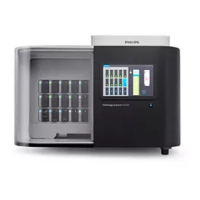
Make sure that there is sufficient free space near the ventilation holes of the scanner to enable
sufficient airflow for cooling.
Definition Specification
On rear side of the scanner > 100 mm
Tab. 31: Necessary free space
Environmental conditions
The scanner is for indoor use where complying with the specified requirements.
Classification of installation and use: Overvoltage category II.
Pollution degree of the intended environment: 2.
Condition Value
Temperature 10 to 35 °C
Temperature change rate ≤ 1 °C/minute
Relative humidity (non condensing) between 50% at 40 °C and 80% at 31 °C
Air pressure 81 - 110 kPa (up to 2000 m altitude)
External vibrations
1
Frequency: 10 - 55 Hz
Amplitude: ≤ 0.15 mm
1
During vibrations, the scanner is not able to produce quality images. The scanner will recover as soon as the vibra-
tions stop.
Tab. 32: Environmental conditions: Operating


 To Next Page
 Loading...