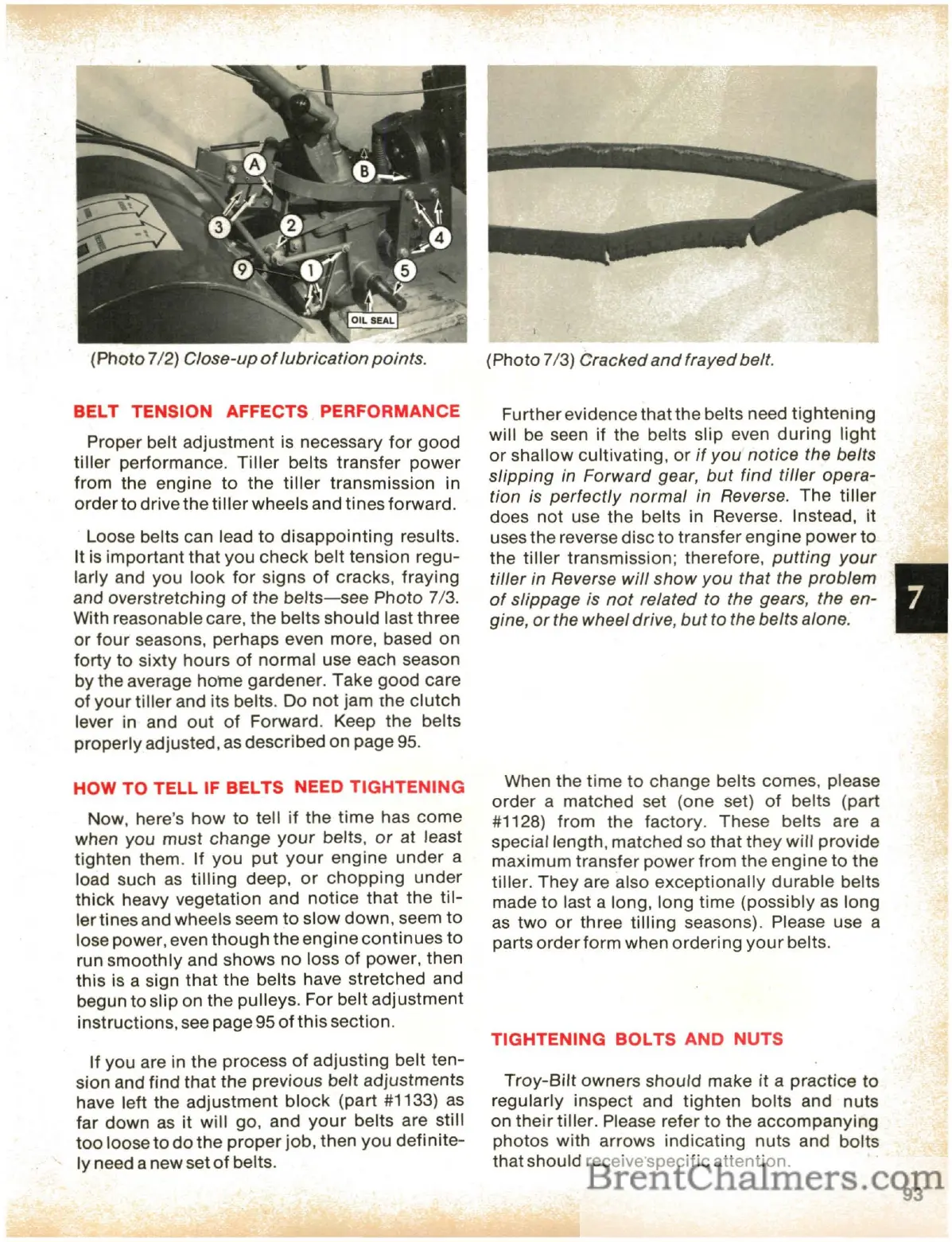
(photo
7/2) Close-up
of
lubrication
points.
BELT TENSION AFFECTS PERFORMANCE
Proper belt adjustment is necessary
for
good
tiller
performance.
Tiller
belts transfer
power
from the engine
to
the
tiller
transmission in
orderto drivethe
tiller
wheels and tines forward.
Loose belts can lead
to
disappointing
results.
It is important that you
check
belt tension regu-
larly and you
look
for
signs
of
cracks,
fraying
and overstretching
of
the
belts-see
Photo
7/3.
With reasonable care, the belts should last three
or
four
seasons, perhaps even more, based on
forty
to
sixty
hours
of
normal
use each season
by the average
home gardener. Take
good
care
of
your
tiller
and its belts. Do
not
jam the
clutch
lever in and
out
of
Forward. Keep
the
belts
properly adjusted,
as
described on page
95.
HOW TO TELL IF BELTS NEED TIGHTENING
Now, here's
how
to tell if the
time
has
come
when you
must
change
your
belts,
or
at least
tighten them. If
you
put
your
engine
under
a
load such
as
tilling
deep,
or
chopping
under
thick
heavy vegetation and
notice
that the
til-
lertines
and wheels seem
to
slow
down,
seem
to
lose power, even
though
the
engine
continues
to
run
smoothly
and shows
no
loss
of
power, then
this is a sign
that
the belts have stretched and
begun
to
slip on the pulleys. For belt
adjustment
instructions, see page 95
of
this
section.
If you are in the process
of
adjusting belt
ten-
sion and find
that
the previous belt adjustments
have left the
adjustment
block
(part #1133)
as
far down
as
it
will
go, and
your
belts are still
too
loose to
do
the
proper
job, then
you
definite-
ly
need a new set
of
belts.
(photo
7/3) Cracked
and
frayedbelt.
Furtherevidence that the belts need
tightening
will be seen if the belts slip even
during
light
or
shallow cultivating,
or
if
you
notice
the belts
slipping
in Forward gear,
but
find tiller opera-
tion
is
perfectly
normal
in Reverse. The
tiller
does
not
use the belts in Reverse. Instead, it
uses the reverse disc
to
transfer engine
power
to
the
tiller
transmission; therefore,
putting
your
tiller in Reverse
will
show
you that the problem
of
slippage is
not
related to the gears, the en-
gine,
or
the wheel drive,
but
to the belts alone.
When the time
to
change belts comes, please
order a matched set (one set)
of
belts (part
#1128) from the factory. These belts are a
special length, matched so
that
they
will
provide
maximum transfer
power
from
the
engine
to
the
tiller.
They
are also
exceptionally
durable
belts
made to last a long, long
time
(possibly as long
as
two
or
three
tilling
seasons). Please use a
parts
order
form
when
ordering
your
belts.
TIGHTENING BOLTS AND NUTS
Troy-8i1t owners
should
make
it
a practice
to
regularly inspect and
tighten
bolts
and
nuts
on
their
tiller. Please refer
to
the
accompanying
photos with arrows
indicating
nuts and bolts
thatshould receive'specific attention.
93


 To Next Page
 Loading...