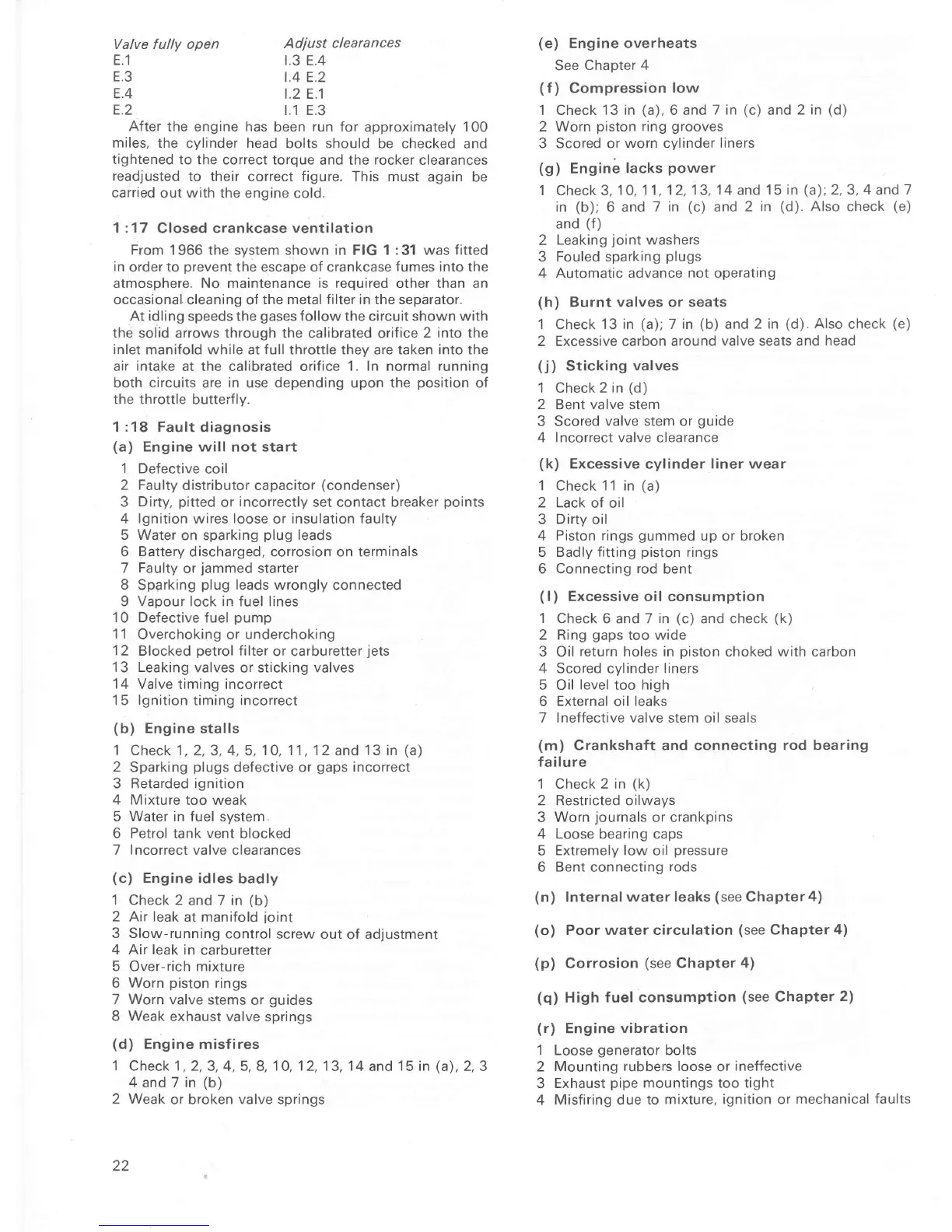
Valve fully open
8.3
E.4
c.z
.Adjust clearcnces
r.3 E.4
1.4 E.2
t.2 8.1
t.1 E.3
AÍter
the engine has
been
run
for approximately 100
miles,
the
cylinder
head
bolts should be checked
and
tightened
to the correct torque
and the
Íocker
clearances
readjusted
to their correct figuÍe.
This
must
again
be
carried
out
with
the engine cold.
1 :17
Closed crankcase
ventilation
From 1966
the
system
shown
in
FIG
1 :31 was fitted
in order to
prevent
the escape
of crankcase
fumes into the
atmosphere. No maintenance is required other than
an
occasional
cleaning oÍ
the metal filter in the separator.
At idling speeds the
gases
follow the circuit shown with
the solid
arrows
through the
calibrated oriÍice
2 into
the
inlet manifold while at full throttle they are taken into the
air
intake
at the calibrated orifice 1. In
normal running
both circuits
are
in use depending
upon
the
position
of
the throttle
butterfly.
1 :18 Fault
diagnosis
(a)
Engine will not start
1 Defective
coil
2
Faulty
distributor capacitor
(condenser)
3
Dirty,
pitted
or
incorrectly
set contact breaker
points
4 lgnition
wires
loose
or
insulation faulty
5
Water
on sparking
plug
leads
6 Battery
discharged, coÍÍosion on terminals
7 Faulty
or
jammed
starter
8 Sparking
plug
leads
wrongly connected
9 Vapour lock in fuel lines
10 Defective
Íuel
pump
11
Overchoking or underchoking
1 2 Blocked
petrol
filteÍ
or carburetter
jets
1
3
Leaking
valves or sticking valves
14 Valve
timing incorrect
15 lgnition
timing
incorrect
(b)
Engine
stalls
1 Check 1,2,3, 4,5, 10, 11,12
and
13 in
(a)
2
Sparking
plugs
defective or
gaps
incorrect
3 Retarded ignition
4 Mixture
too weak
5 Water in fuel
system.
6 Petrol
tank
vent
blockeo
7 lncorrect valve clearances
(c)
Engine idles
badly
1
Check 2
and 7
in
(b)
2 Air leak
at manifold
ioint
3 Slow-running
control screw
out of adjustment
4 Air leak
in
carburetter
5 Over-rich mixture
6 Worn
piston
rings
7 Worn
valve
stems or
guides
8 Weak
exhaust valve springs
(d)
Engine
misfires
1 Check 1,2,3,4,5,8,10, 12,13,14
and
15 in
(a),2,3
4 and 7 in
(b)
2 Weak
or broken
valve
springs
22
(e)
Engine overheats
See
Chapter 4
(f
)
Compression
low
1
Check
13 in
(a).
6 and
7 in
(c)
and 2 in
(d)
2 Worn
piston
ring
grooves
3 Scored or
woÍn
cvlinder
liners
(g)
Enginà
lacks
power
1 Check 3, 10,
11,12, 13, 14
and
15
in
(a);2,3,4and-7
in
(b);
6 and
7 in
(c)
and 2
in
(d).
Also check
(e)
and
(Í)
2
Leaking
joint
washers
3
Fouled
sparking
plugs
4 Automatic
advance not operating
(h)
Burnt valves or seats
1
Check
13 in
(a);7
in
(b)
and
2 in
(d).
Also
check
(e)
2 Excessive carbon around
valve seats and head
(j)
Sticking valves
1 Check 2 in
(d)
2
Bent
valve stem
3 Scored
valve stem or
guide
4 Incorrect valve clearance
(k)
Excessive cylinder liner wear
1 Check 11 in
(a)
2 Lack
of oil
3
Dirtv
oil
4 Piston rings
gummed
up
or broken
5
Badly Íitting
piston
rings
6 Connecting
rod
bent
(l)
Excessive oil consumption
1
Check 6 and 7
in
(c)
and check
(k)
2 Ring
gaps
too wide
3
Oil
return
holes in
piston
choked with carbon
4 Scored
cvlinder
liners
5 Oil
level
too
high
6
External
oil
leaks
7 InefÍective valve stem
oil
seals
(m)
Crankshaft and connecting
rod
bearing
f
ailure
1 Check 2 in
(k)
2 Restricted oilwavs
3
Worn
journals
or crankpins
4
Loose
bearing caps
5
Extremely low oil
pressure
6
Bent
connecting
rods
(n)
lnternal water
leaks
(see
Chapter
4)
(o)
Poor water circulation
(see
Chapter 4)
(p)
Corrosion
(see
Chapter
4)
(q)
High fuel consumption
(see
Chapter
2)
(r)
Engine
vibration
1 Loose
generator
bolts
2
Mounting rubbers loose or ineÍfective
3
Exhaust
pipe
mountings
too tight
4 Misfiring due
to mixture, ignition or
mechanical faults


 To Next Page
 Loading...