2
) The breaker will trip in the event of loss of voltage to the undervoltage release (I)
It is possible to install tilt sensors afterwards. Ask ABB E-mobility B.V.. Refer to
section 1.11.
3.8 Cable management system
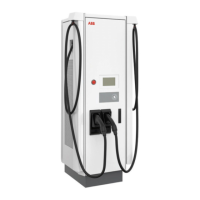
The EVSE has a cable management system, that retracts the cables and holds the
cables in position when the EVSE is not in use.
3.9 Power allocation strategies
Before the manufacturer starts the commissioning procedure, you must select one
of the power allocation strategies.
The configuration of the EVSE allows for these power allocation strategies:
Power allocation strategy
Available for EVSE models Reference
Sequential All models Section 3.9.1
Concurrent Models with more than
one DC outlet
Section 3.9.2
Dynamic 'First In First Ser-
ved'
Models with more than
one DC outlet
Section 3.9.3
Dynamic 'Shared power' Models with more than
one DC outlet
Section 3.9.4
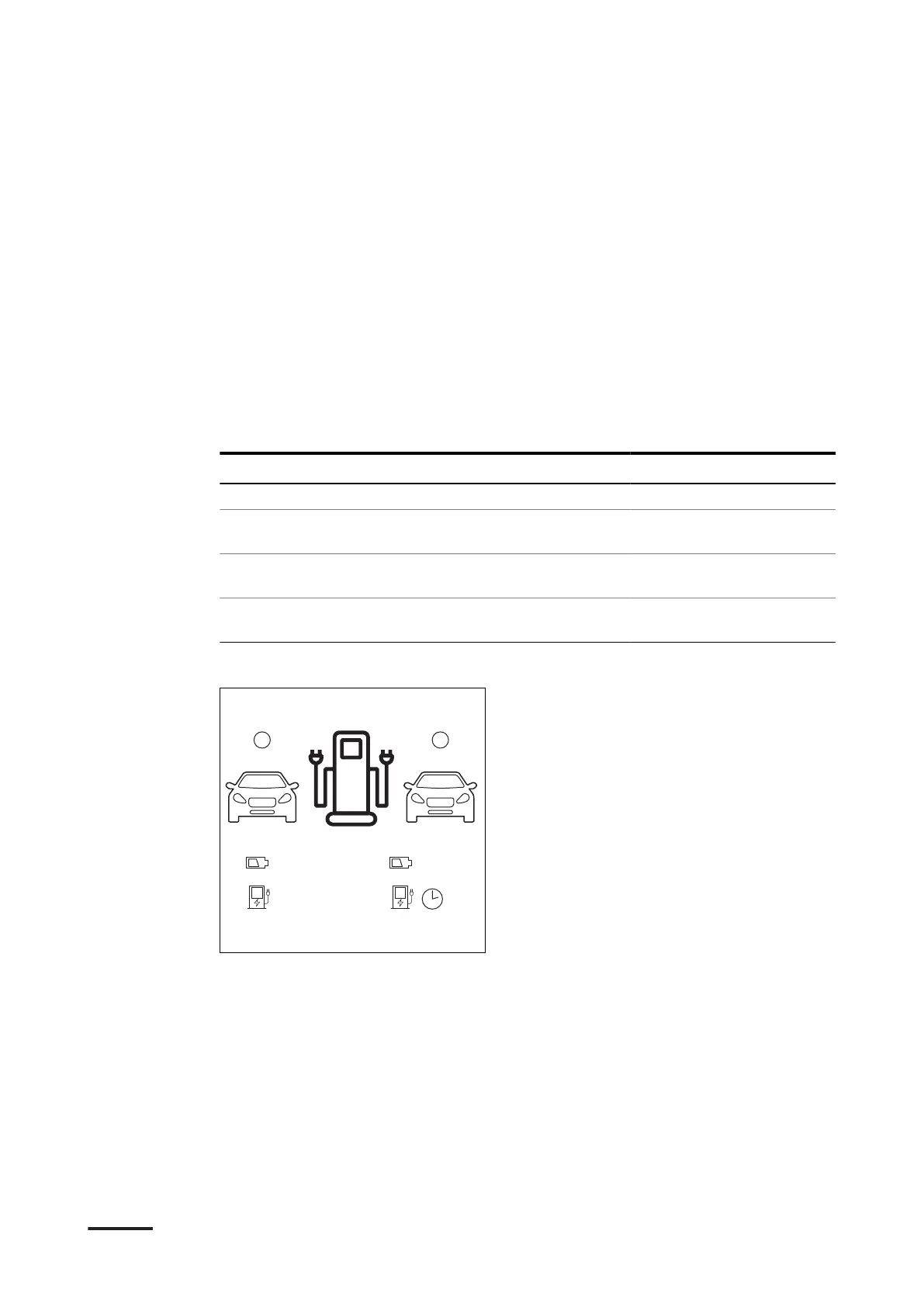
3.9.1 Sequential power allocation
When the EVSE is configured for sequential power allocation, it can serve one EV at a
time with DC fast charging.
In this configuration the EV charging power is the maximum power available to
the EVSE, the rated power output. Effectively the maximum power output can be
less than the rated power output because of power constraints. For example, the
power output can be permanently limited due to site current or power constraints,
or temporarily limited by power management systems.
Only one DC charge session can be performed at a time. When a second EV is
connected to the EVSE, the EVSE must first finalize the first charge session before a
new charge session can start.
Description
46 9AKK108467A6398-EN | 002


 To Next Page
 Loading...