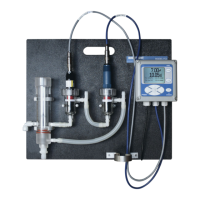
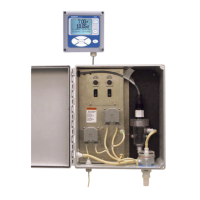
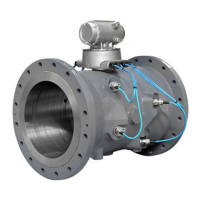
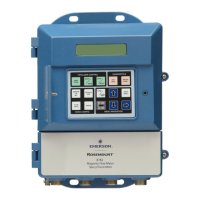
Rosemount Model 1195/ProPlate/Mass ProPlate
2-22
Equipment Required Proper remote mount installation of the ProPlate electronics requires
the following tools and equipment.
Tools Required Tools required include the following:
1. Open end or combination wrenches (spanners) to fit the pipe
fittings and bolts:
9
/16-in.,
5
/8-in.,
7
/8-in.
2. Adjustable wrench: 15-in. (1½-in. jaw).
3. Nut driver:
3
/8-in. for vent/drain valves (or
3
/8-in. wrench).
4. Phillip’s screwdriver: #1.
5. Standard screwdrivers: 6-in., and
1
/8-in. wide.
6. Pipe wrench: 14-in.
7. Wire cutters/strippers.
Supplies Required Supplies required include the following:
1. ½-in. Tubing (recommended) or ½-in. pipe to hook up the ProPlate
electronics to the sensor probe. The length required depends upon
the distance between the electronics and the sensor.
2. Fittings including, but not limited to:
a. Two tube or pipe tees (for steam or high temperature liquid)
b. Six tube/pipe fittings (for tube)
3. Pipe compound or teflon tape (where local piping codes allow).
INSTRUMENT MANIFOLDS An instrument manifold is recommended for all installations. A
manifold allows an operator to equalize the pressures prior to the zero
calibration of the ProPlate electronics as well as to isolate the
electronics from the rest of the system without disconnecting the
impulse piping. Although a 3-valve manifold can be used, a 5-valve
manifold is recommended. Figure 2-26 identifies the valves on a 5-valve
and a 3-valve manifold.
5-valve manifolds provide a positive method of indicating a partially
closed or faulty equalizer valve. A closed for faulty equalizer valve will
block the DP signal and create errors that may not be detectable
otherwise. Figure 2-26 shows the DP manifold assembly and identifies
the valves on both types of manifolds, and Table 2-1 provides a
description of the valves. The labels for each valve will be used to
identify the proper valve in the procedures to follow.
NOTE
Some recently-designed instrument manifolds have a single valve
actuator, but cannot perform all of the functions available on standard
5-valve units. Check with the manufacturer to verify the functions that
a particular manifold can perform. In place of a manifold, individual
valves may be arranged so as to provide the necessary isolation and
equalization functions.


 To Next Page
 Loading...