ELECTRICAL COMPONENTS
8-115
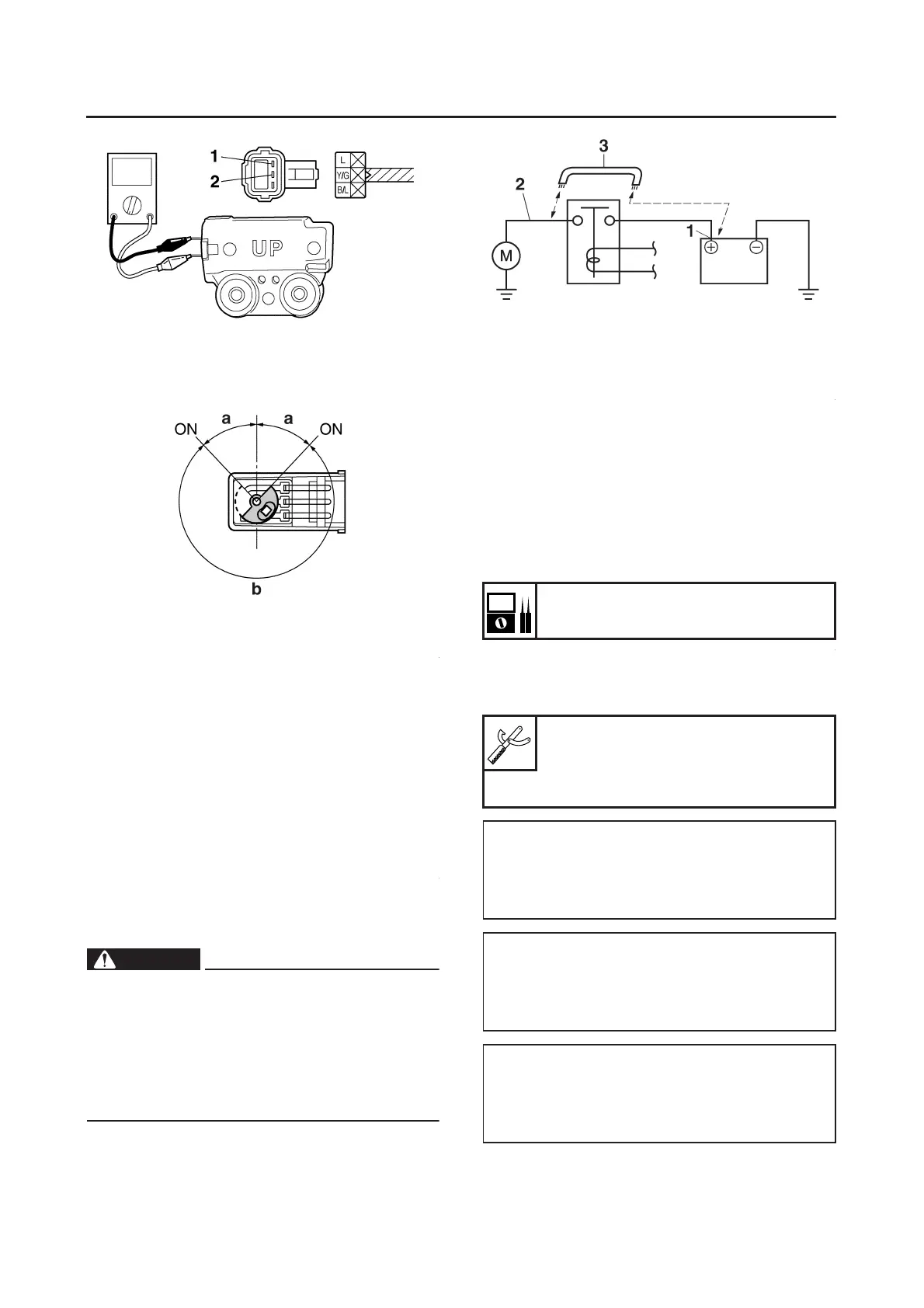
c. When turn the lean angle sensor to 45°.
d. Measure the lean angle sensor out put volt-
age.
▲▲▲▲▲▲▲▲▲▲▲▲▲▲▲▲▲▲▲▲▲
EAS15B1011
CHECKING THE STARTER MOTOR
OPERATION
1. Check:
● Starter motor operation
Does not operate → Perform the electric
starting system troubleshooting, starting with
step 4.
Refer to “TROUBLESHOOTING” on page
8-13.
▼▼▼▼▼▼▼▼▼▼▼▼▼▼▼▼▼▼▼▼▼
a. Connect the positive battery terminal “1” and
starter motor lead “2” with a jumper lead “3”.
WARNING
EWA13810
● A wire that is used as a jumper lead must
have at least the same capacity of the bat-
tery lead, otherwise the jumper lead may
burn.
● This check is likely to produce sparks,
therefore, make sure no flammable gas or
fluid is in the vicinity.
b. Check the starter motor operation.
▲▲▲▲▲▲▲▲▲▲▲▲▲▲▲▲▲▲▲▲▲
EAS28150
CHECKING THE STATOR COIL
1. Disconnect:
● Stator coil coupler
(from the wire harness)
2. Check:
● Stator coil resistance
Out of specification → Replace the stator coil.
▼▼▼▼▼▼▼▼▼▼▼▼▼▼▼▼▼▼▼▼▼
a. Connect the pocket tester (Ω × 1) to the stator
coil coupler as shown.
Stator coil resistance
0.22–0.26 kΩ at 20 °C (68 °F)
Pocket tester
90890-03112
Analog pocket tester
YU-03112-C
Positive tester probe
White “1”
Negative tester probe
White “2”
Positive tester probe
White “1”
Negative tester probe
White “3”
Positive tester probe
White “2”
Negative tester probe
White “3”


 To Next Page
 Loading...