190-01115-01 G3X™/G3X Touch™ Avionics Installation Manual
Rev. AV Page 2-7
2.1.1.10 Navigation
Basic VFR GPS navigation with the G3X system is performed by the GDU displays, using their internal
navigation databases in conjunction with GPS data from GDU GPS receivers or the GPS 20A. Flight plan
entry and modification is also performed using the GDU displays. For VFR operations, no other source of
navigation data is required.
The G3X system also supports up to two external navigation sources. Supported external navigation
sources include IFR GPS, VHF NAV, and GPS/NAV receivers.
Lateral and vertical deviation (CDI/VDI) and status data from external navigators is displayed on the GDU
displays, as well as external GPS navigator flight plan information. On-screen controls allow switching the
current source of navigation data between multiple external sources, as well as to the G3X system’s
internal flight plan for VFR navigation.
The Garmin GNC® 355 radio, GNS™ 4XX/5XX receiver, GNX™ 375 IFR navigator, GPS 175, and
GTN™ 6XX/7XX moving map navigators are supported by the G3X system, including WAAS approach
capability. This integration requires the use of a GAD 29 ARINC 429 interface module. GPS navigation
data is provided to the G3X system through one
RS-232 input and one ARINC 429 input for each GNC 355, GNS 4XX/5XX, GNX 375, GPS 175, and
GTN 6XX/7XX IFR GPS navigator unit. The G3X system sends flight data and selected course
information back to the external GPS navigator through an ARINC 429 output.
The G3X system uses an additional ARINC 429 input to receive VOR, localizer, and glideslope deviation
information from a Garmin GTN 650/750 or GNS 430/480/530 IFR GPS/NAV receiver.
VOR, localizer, and glideslope information from a Garmin GNC 255, GNC 215, or SL30 VHF NAV
receiver is also supported. These radios connect to the G3X system using an RS-232 connection to a GDU
display.
When two external navigation sources are connected to the G3X system, the determination of which
source is #1 and which is #2 is determined by the ordering of the RS-232 connections to the GDU displays.
The #1 navigation source should be connected to a lower-numbered RS-232 port on the PFD1 GDU, and
the #2 navigation source should be connected either to a higher-numbered RS-232 port on the PFD1 GDU,
or to any RS-232 port on the MFD1 GDU. For additional information, refer to Section 2.5.1
.
The G3X Touch system can send basic flight plan data to a GNC 355, GNS 4XX/5XX, GNX 375,
GPS 175, or GTN 6XX/7XX IFR GPS navigator, allowing VFR flight plans to be created on the G3X
system and uploaded to the IFR navigator. The GDU 4XX display in a G3X Touch system can also act as
a relay between the GNC 355, GNS 4XX/5XX, GNX 375, GPS 175, and GTN 6XX/7XX IFR GPS
navigator and a tablet computer using Bluetooth (see Section 2.1.1.23
). Flight plan transfer capability
requires a second RS-232 connection between the PFD1 GDU and the #1 GNC 355, GNS 4XX/5XX,
GNX 375, GPS 175, or GTN 6XX/7XX IFR GPS navigator, using the “Connext®” RS-232 format. The
Connext® computer application and Bluetooth are not supported by the legacy G3X system and GDU 37X
display.
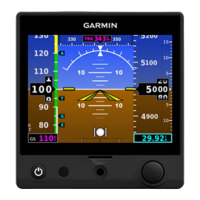
If a G5 standby display instrument is installed, data from the external navigation source selected on the
G3X PFD is also displayed on the G5. This requires an ARINC 429 connection between the navigator,
GAD 29, and G5.
For detailed information on connecting external navigators to a G3X system, refer to Section 24
.


 To Next Page
 Loading...